
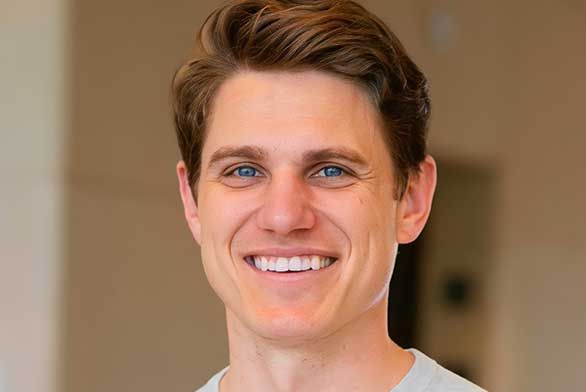
Program Polymath: Catching Up With Tech Founder, U.S. Marine Corps Veteran, and Debut Author Mike LeBlanc (A09)
February 11, 2026
On a chilly day in early December, inside a converted industrial building in San Francisco’s SoMa neighborhood—a rapidly growing hub of artificial intelligence start-ups—Mike LeBlanc’s (A09) colleagues at Foundation Robotics were hard at work dissecting a human hand.
“Instead of looking at a diagram and just taking for granted how the hand works,” LeBlanc says, “they were really able to look at the tendons, to look at the muscles—to really see how it is that we achieve the miracle of being able to, say, hold our groceries while finding our keys at the same time. The human hand is an incredible example of how to design something that interacts with the world.”
Michelangelo famously dissected cadavers to recreate flesh from marble. LeBlanc, a co-founder of Foundation Robotics, and his team share a similar goal of reverse-engineering a cadaver’s hand in steel and plastic. A small-scale feat like this one would be a giant step forward in the company’s ongoing quest to create a new generation of AI-powered anthropomorphic robots capable of working in factories, exploring space, and fighting wars.
“One of the biggest challenges with humanoids and building a human-shaped robot is the hands,” LeBlanc explains. “You need high dexterity. And nobody has it yet.” Hence the scalpels—which, the Johnnie alum wryly adds, served as a stand-in for a Proustian madeleine by transporting him right back to Freshman Lab, one of his favorite classes as an undergraduate.
A fitting journey, considering that LeBlanc first began seriously thinking about what makes us human—and how he wanted to help shape humanity—while at St. John’s. True to his alma mater’s interdisciplinary spirit, LeBlanc is also a Program polymath: a former United States Marine Corps officer and soon-to-be-published author who entered the world of high-tech robotics by way of Harvard Business School.
LeBlanc was born and raised in Lyndhurst, Ohio. His father was a house painter, and his mother was a teacher. As for himself, he recalls being a self-described teenage “goof-off” who drifted aimlessly through high school while harboring few, if any, ambitions for college and beyond. Still, he enjoyed reading and writing enough that an English teacher took notice, informing LeBlanc that she knew just the place for him: a small yet rigorous liberal arts school called St. John’s College. Her recommendation galvanized LeBlanc into action, and he wound up applying to St. John’s and only St. John’s. After initially being turned away due to poor grades, he boldly informed admissions that he “rejected their rejection,” he laughs. “I had goofed around in high school, but, as I wrote in my letter, that wasn’t a real gauge of my mind. They wrote back and said if I could get A’s in all the classes I didn’t do well in at high school, I could attend.”
LeBlanc arrived in Annapolis with a stint in community college (and the requisite A’s) under his belt. Newly committed to academics, he enjoyed the Program’s natural science offerings and developed a lifelong passion for ancient Greek and classical authors such as Aristotle, Herodotus, and Thucydides. Their writings on diplomacy, conflict, and leadership culminated in a personal epiphany: “I’ll never forget,” LeBlanc says, “that I was sitting and reading the History of the Peloponnesian War, and thinking, ‘Wow, these men are directing history.’ Suddenly, I had an insight: I wanted to be one of those people.” When LeBlanc’s mentor, St. John’s Annapolis tutor emeritus Carl Page, suggested he consider enlisting in the military after graduation, LeBlanc heeded the advice and joined the Marines.
LeBlanc completed three tours of the Middle East and rose through the ranks as captain. He eventually left the military to get married, start a family, and attend Harvard Business School—a pivot he chronicles in his debut book, What If Anger Is the Answer? A Harvard Marine’s Guide to Shaping Aggression. Distributed by Simon & Schuster and slated for release in August 2026, the work can perhaps best be described as a military memoir-meets-classical philosophy crash course geared toward aspiring titans of industry. LeBlanc provides the reader with actionable business tips gleaned from books and battle, all while reflecting on the ancient Greek concept of thumos: a potent yet potentially toxic amalgamation of anger, spiritedness, ambition, competitiveness, and self-righteousness. Along the way, he illustrates the many guises of thumos while showing why it can make a powerful servant, if not a terrible master. While the book is ostensibly about anger, it’s also about pursuing a good life through gaining a better understanding of what makes us human.
Which, of course, brings us full circle back to St. John’s College—and, indirectly, back to humanoid robots. LeBlanc partially attributes his second act in Silicon Valley to his mentor, Page, who now lives near him in California and continues to serve as a sounding board in both career and life. As a tutor all those years ago, Page had suggested that LeBlanc would be well-suited for a business career, if not the military. These seemingly disparate vocational recommendations converged in 2024 when LeBlanc co-founded Foundation Robots alongside tech investors and entrepreneurs Arjun Sethi and Sankaet Pathak.
“We are the only ones that are trying to put these humanoid robots in war—and not just in logistics for the Navy or Air Force, but to really go out there and be on the front lines,” LeBlanc says. “Being able to send aluminum and steel to war instead of a 19-year-old is, in my mind, a very noble goal.” A goal he might have never considered without guidance from Page and the Great Books at St. John’s College.