

Santa Fe Wilderness Excursion Program Bridges Great Books and the Great Outdoors
By Helen Wagner (A26) | January 12, 2026
Deep in New Mexico’s protected Pecos Wilderness area, a group of Johnnies hiked through a landscape of half-singed trees. The blue sky stretched above them. Charred trunks and broken branches littered the hillsides by the trail. They were in a burn scar, a swathe of the forest visited by a wildfire. It was an eerie but beautiful sight.
Louise Harden (A26), who was a sophomore at the time, saw it and thought about the battle scenes of Homer’s Iliad, which she had read in freshman seminar. Some of the fallen trees were young, reminding her of the young soldiers who went to war at the walls of Troy. Harden’s group was miles from school, with no books or classrooms in sight. But Homer’s stories stayed in her mind. This was still St. John’s College— just a slightly more open-air version.
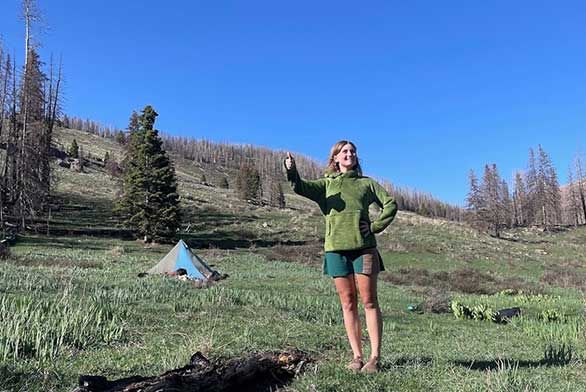
Harden and her friends were on a backpacking trip with the Outdoor Program, an extracurricular group at St. John’s Santa Fe that supplements the college’s rigorous academics with opportunities for wilderness adventure. It’s one of the most popular programs on campus—perhaps not surprisingly, considering its scenic location in the foothills of the Sangre de Cristo Mountains.
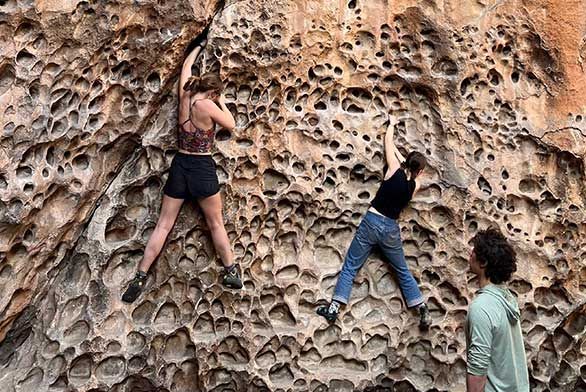
Several hiking trails begin right behind St. John’s Santa Fe, just a few steps away from the residence halls; students can climb 338 feet for a view from neighboring Monte Luna after their morning classes or summit Atalaya Mountain before dinner on a Saturday. For those craving more action, Outdoor Program members facilitate camping, backpacking, rock climbing, mountain biking, and skiing trips on weekends and over seasonal breaks. They also maintain an outdoor equipment lending library for students to set off on their own.
Despite all their reading and essay-writing, there’s more to Johnnies than their intellects. In Santa Fe, the Outdoor Program helps them remember they’re also embodied creatures. “In an academic setting, your body is just a thing that moves your brain from place to place,” says Harden, now a senior at St. John’s Annapolis, where she spent her freshman year before transferring to Santa Fe for two years. “But in the outdoors, there’s a total engagement with the body that can’t be ignored. You’re not only engaging with Program texts as just a matter of the mind, but also as a matter of life; a matter of total being.”
In addition to organizing trips, the Outdoor Program also runs a leadership program for students interested in being outdoor guides. The training consists of an 80-hour Wilderness First Responder certification—essentially a backcountry EMT—that’s paid for by the college, and a 12-day backpacking trip where students learn the basics of wilderness navigation and risk management. “We aim to give students real, tangible leadership skills,” says Mike Thurber, Director of Outdoor Education and Recreation at St. John’s Santa Fe. “They can carry this forward in a career in the outdoor industry if that’s what they want to do, but these skills are also very broad. They’re applicable to the St. John’s Program, to their community, and to the rest of their life.”
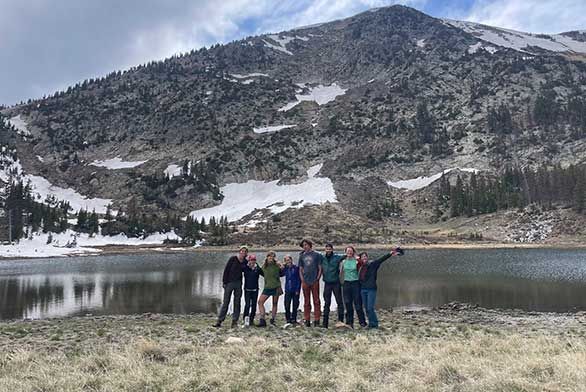
After completing their 12-day backpacking trip, students in the leadership program act as guides on the annual Santa Fe freshman orientation backpacking trip before the new school year begins. Around one-fifth of incoming students opt into the six-day adventure, as it provides an immersive introduction to the wilderness surrounding Santa Fe as well as their new community. There’s nothing like new friendships forged over hiking, eating, and sleeping together in tents.
“You get to know people in a different way by means of the outdoors,” says Harden, who completed the Outdoor Program leadership training program and worked as a guide on a peak-bagging orientation trip. “I think it’s a great introduction to St. John’s to be able to go into the wilderness with people. You come out friends, kind of no matter what.”
Students who complete said leadership training and guide the freshmen on their orientation trip are then eligible for work-study with the Outdoor Program, where they act as paid guides for outdoor trips throughout the year. Activities on these excursions, which include hiking, rock climbing, kayaking, and skiing, have taken students to locations near, like the Pecos Wilderness, and far, like the Sea of Cortez.
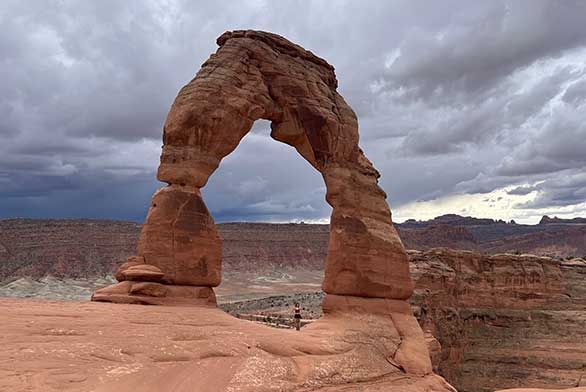
During spring break several years ago, members coordinated their first international trip to Baja California, circumnavigating an island off the coast of La Paz with sea kayaks. Other trips have included touring Arches National Park during the college’s annual Long Weekend break in October, backpacking through Arizona’s Tonto National Forest, and paddling Utah’s breathtaking Lake Powell.
It’s tradition over Thanksgiving break to travel to Colorado’s Wolf Creek Ski Area, where students get their fill of skiing and feasting in the snowy San Juan Mountains. Van rides, ski lodges, and tents provide downtime for seminar reading—but in true Johnnie fashion, everyone inevitably brings too many books for an overnight backpacking trip. “Don’t bring Don Quixote. You are not going to finish Don Quixote,” Harden jokes. For her, the outdoor trips are a different kind of Johnnie experience, albeit one with equal importance.
“The work I do at St John’s, despite all the round-table classes, can sometimes feel like a solitary project,” Harden reflects. “We spend a lot of time reading to ourselves and thinking for ourselves. But the Outdoor Program reminds me that’s not how things are. Engaging with other people in the wilderness is intense. You rely on them for your safety. That shapes the way that I understand the whole [St. John’s] Program as a collaborative project. None of this can ever be a solitary encounter. It’s not me and a book. It’s me and an author who was also in a community, no matter how isolated some of our authors tried to make themselves.”
Just like the St. John’s Program, the Outdoor Program is a collaborative project that spans multiple generations of students while simultaneously uniting them. Its seeds were planted sometime in the 1970s with the St. John’s Search and Rescue Team, comprising students, tutors, and local community members. It remained active for several decades, working to aid lost hikers in the wilderness and mountains. The Search and Rescue Team dissolved in the late 2000s and morphed into the Santa Fe-based Atalaya Search and Rescue, which continues to serve the same region. Still, its founding spirit is alive and well on campus.
“At the time, there was a more ad-hoc culture of St. John’s faculty and staff organizing outings,” says Thurber, who officially became Santa Fe’s Outdoor Program Coordinator in 2009. Today, his group plays a robust part in campus life, with around one-third of the student body participating in its trips, according to Thurber’s estimate.
“What we do on these trips is really sort of a microcosm of the rest of our existence in community,” Thurber says. “We have this small bubble of community—10 or 15 people—who are all going through the same challenges, the same bad weather, the same cold temperatures, the same early mornings. I don’t really care whether somebody comes on a backpacking trip and becomes a great backpacker. What I really care about is that they take those lessons from that experiential container and bring them into the rest of their lives. We learn how to navigate challenge and conflict, and how to carry ourselves among peers, and we bring that into our communities, specifically our little community of learning here at St. John’s.”
Harden exemplifies this Johnnie experience in her own outdoor adventures. “You must develop a trust in other people in the outdoors,” she says, “because other people are carrying your food, and other people are getting your water, and other people are helping you stand up with your backpack on, because you can’t do it alone. That trust is part of what makes the Program possible—you must trust that your classmates are capable, invested, and speaking in good faith. And you develop that kind of trust, quickly and necessarily, in the outdoors.”
Most trips organized by the St. John’s Outdoor Program are free for students, except for those that require third-party guides or longer-term travel, such as the trip to Baja California. But even these are “wildly subsidized and inexpensive,” according to Thurber, making the outdoors accessible to any Santa Fe Johnnie who hears the call of the wild.