
Annapolis Class of 2026 Celebrates the Power of Great Books—And Even Greater Friendships
May 13, 2026 | By Jeremy Richter (A28)
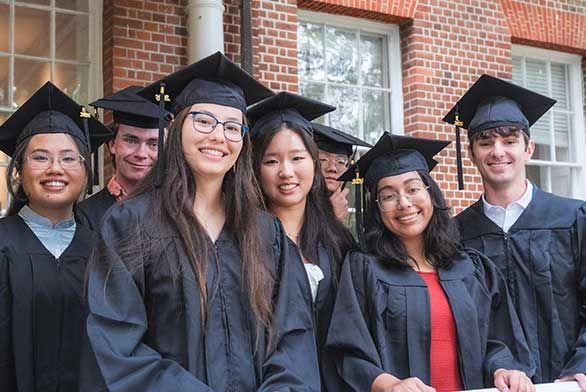
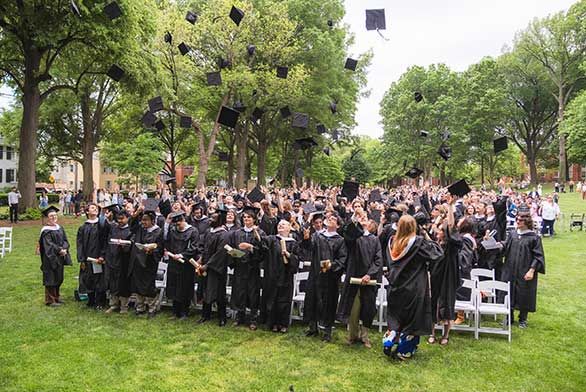
Hundreds of students, parents, alumni, and guests gathered on the front lawn of St. John’s College Annapolis on Saturday, May 9, under partly cloudy skies as more than 140 members of the Class of 2026, including undergraduates and students in the Graduate Institute’s Master of Arts in Liberal Arts program, received their diplomas.
This year’s Commencement speaker was tutor Rebecca Goldner (AGI02). Goldner, who has served as a tutor in Annapolis since 2014, was invited to deliver this year’s address by the graduates themselves.
Goldner studied classics at Bowdoin College and the University of Pennsylvania before earning her Master of Arts from the St. John’s Graduate Institute. She went on to receive her PhD in philosophy from Villanova University, where her dissertation examined Aristotle’s De Anima.
Goldner opened her address with a question she regularly asks seniors: “What will you read next?” That question, she explained, rests upon the conviction that “to be a Johnnie, you have to be a reader ... you have to choose books, books of any sort, as companions. You see books as real beings, beings with whom you are willing to spend quite a bit of time.”
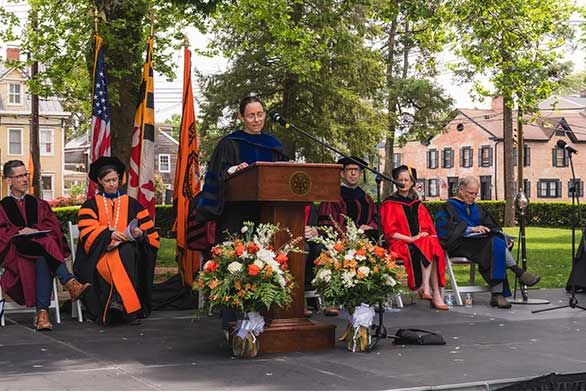
“Reading is a matter of freedom and reading is a matter of friendship,” Goldner continued. Drawing on Frederick Douglass, whose 1845 autobiography recalls a former enslaver’s remark that literacy would make Douglass “forever unfit to be a slave,” Goldner emphasized the transformative power of reading as a means to “place oneself beyond the path that seems inevitable.”
“Reading,” she said, “tears us away from the present and launches us into the world offered to us by an author. Thus, to read is to find oneself at home, ever so briefly, in the mind of someone else. It is to enmesh oneself in someone else’s words and thoughts.”
Goldner’s address closed with a reference to Program protagonist Don Quixote, whom she called a “hero for the day.”
Quixote, she points out, was “a man who saw a world in disarray and sought to remake that world in the imaginative vision of his books.”
“Quixote did not remain passive; he found liberation through reading and sallied forth ... After having been a lonely, isolated man, Quixote populated his ideal world with real people, true friends, those who are with him as his story comes to an end. Who better to teach us that reading is a matter of freedom and a matter of friendship?”
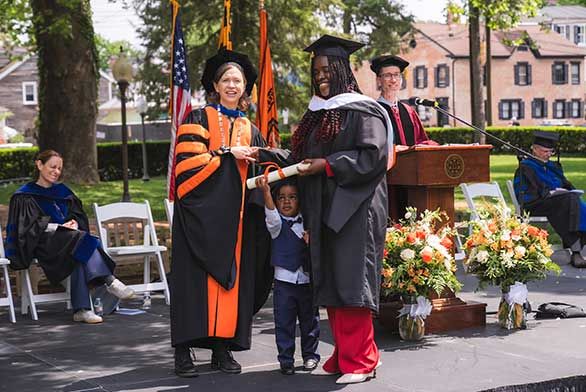
St. John’s Annapolis President Susan Paalman, Dean Joe Macfarland, and Associate Dean for Graduate Programs Brendan Boyle also addressed the graduates before diplomas were conferred.
During her address, Paalman expressed hope that the Class of 2026 would channel the spirit of their St. John’s College education throughout their lives.
“In the Republic, as Socrates and Glaucon are discussing the right kind of education, Socrates describes the best kind of education as a sort of amusement, undertaken freely,” Paalman said. “The education you participated in here is characterized by serious play of the sort that Socrates would recognize.”
“Over the last four years, you each have explored many readings with hard work but also with playfulness, freely inquiring into the deepest questions ... I hope that you will never lose the spirit of free and playful learning.”
As the ceremony concluded, the Class of 2026 tossed their caps into the air in their own moment of play before enjoying a celebratory reception on the campus back lawn.
Later this month, on Saturday, May 23, nearly 120 members of the Santa Fe Class of 2026, including undergraduates and students in the Graduate Institute’s Master of Liberal Arts and Master of Eastern Classics in-person and low-residency programs will walk the stage in a ceremony featuring keynote remarks from former U.S. Senator Ben Sasse (AGI98).