

Law Club in Annapolis Explores a Popular Johnnie Career Path, Seminar-Style
May 7, 2026 | By Elio Shiffman (A27)
Given the Program’s dense curriculum, one might think that Johnnies wouldn’t have the time to indulge in reading interests outside their assignments. Still, members of the school’s Law Club in Annapolis find a way. They use online archives of various notable trials and petitions to study law and its practical applications in the United States legal system—and, while reading judicial opinions and discussing Supreme Court rulings may seemingly not appeal to anyone who isn’t an aspiring lawyer, it’s not hard to see why a group like this would flourish at St. John’s, especially given the fact that some major decisions are read in Senior seminar.
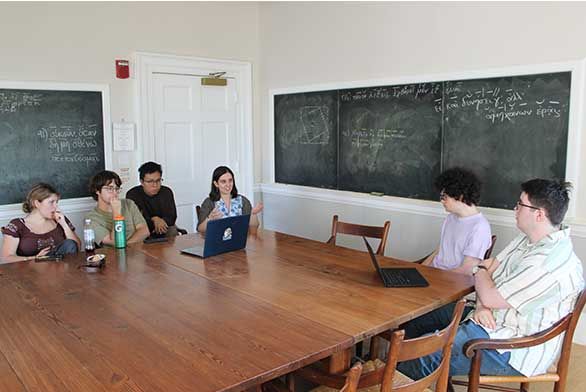
Founded in spring 2024, the Law Club predominantly functioned as an LSAT preparation group. It soon evolved into something a little different—and a lot more Johnnie—with organizers providing their peers with expansive, seminar-style overviews of landmark suits while highlighting various areas of practice such as eminent domain, civil rights law, and contract law.
These changes were brought about by current Law Club archon Mary “Bo” Bednar (A27), who assumed her role in 2025. Describing the decision to shift focus from test prep to a more generalized case study format, she opines, “At St. John’s, the classes prepare you for law school already. We spend all week practicing logic. I think most Johnnies can do very well on the LSAT without studying it directly, just through [reading] these other texts.” (For those seeking more structure on their test-prep journey, a sub-group operating under the auspices of Law Club continues to provide LSAT assistance and support.)
Reading trial proceedings and opinions, meanwhile, grants important perspectives: “I think Law Club is a way to sort of try on what it’s like to be a property lawyer or a family lawyer, or all these different types of law, and find out which ones fascinate you,” Bednar says. The Law Club has covered topics from discussing the application of the War Powers Resolution to writing a case brief on Katzenbach v. McClung, a commerce clause case involving the Civil Rights Act. Exploring various facets of the profession is important for Johnnies applying for legal internships or working on law school applications: “Law school,” she advises, “is too expensive not to know that you really want to do it before you go.”
Many students at St. John’s College do take that pivotal next step: Since 2012, 100 percent of Johnnie applicants have successfully gained admission to law school, including prestigious programs at Harvard, Georgetown, and Stanford. This, perhaps more than anything, attests to the Program-cultivated skills such as deep reading, attention to detail, and calm, logical discussion that allow future Johnnie lawyers to thrive. Meanwhile, engaging in extracurricular seminars on these Supreme Court opinions allows for direct application of said skills while interpreting case law and underlying arguments. Discussing her criteria for selecting various cases for discussion, Bednar tries “to find cases that have really difficult issues that there’s not a clear answer [for] based on the Constitution.” This allows club members to explore various angles and conduct research on precedents to draw their own independent conclusions.
Recently, the club has experimented with listening to recordings of Supreme Court cases. This stimulates real-time discussion, often allowing members to contribute thoughts throughout that are frequently later brought up by a lawyer or court justice. Listening to how a case is argued in a real-life court setting while reading along with the transcript, without foreknowledge of its details, encourages debate about what the argument is, why it’s being formulated in a specific way, and where it might end up. They occasionally also watch local trials. When Law Club isn’t conducting on-campus meetings, the school’s walking proximity to locations such as the Circuit Court for Anne Arundel County and the Annapolis District Court allows for field trips to observe real legal proceedings.
Aside from burnishing one’s pre-law resume and providing a structured study environment, the most valuable aspect of Law Club, in Bednar’s eyes, is that it provides opportunities to discuss the law at length—a rare occurrence for most college students outside the classroom, but not for Johnnies accustomed to running their own seminars. “Even though it’s not very common for undergraduates to do that kind of thing,” Bednar says, “we totally can do it.” In fact, St. John’s sets up its students to do just this sort of thing.