
From Campus Roosters to Faraday Cages, Retiring Annapolis Lab Director Mark Daly (AGI12) Reflects on More Than 40 Years of Memories
March 26, 2026 | By Helen Wagner (A26)
“Cock-a-doodle-doo!”
Many years ago, if you were walking on the second floor of Mellon Hall at St. John’s College in Annapolis, you might have heard a rooster crowing from behind a classroom door. “Why is there a rooster up here?” you might have wondered, “and who’s in charge of it?” The answer to both questions would have been longtime St. John’s Lab Director Mark Daly.
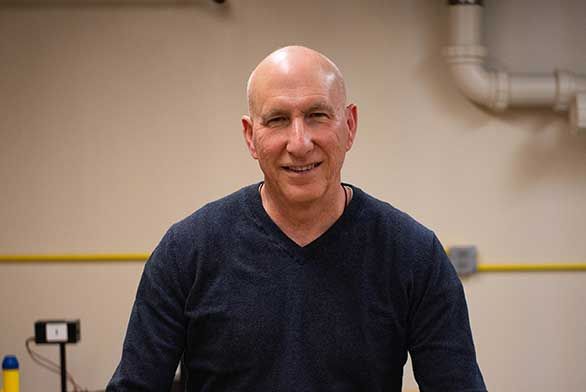
Since 1985, Daly has served as director of the St. John’s Laboratory Program in Annapolis, where he collaborates with tutors and student lab assistants to run the college’s many-faceted science program. He officially retired last summer, but he's remained on campus on an interim basis for the past two semesters, helping to show a new director the ropes while tying up loose ends. He’ll say his final goodbyes to St. John’s Annapolis this coming school year with 41 years' worth of memories under his belt—including, but not limited to, raising a rooster on campus.
It’s hard to encapsulate Daly’s various responsibilities in even a few short sentences. He refers to himself as a “jack-of-all-trades” whose day-to-day duties include organizing lab equipment, incubating experimental chicken eggs (and caring for the inevitable hatchlings, hence the rooster), protecting classrooms from the dangers of mercury poisoning, and building a quantum lab in the basement of Mellon Hall. When I asked him if he could explain his job description in his own words, he laughed and said, “No.”
Daly first arrived at St. John’s Annapolis in 1985 with a biology degree from Pennsylvania’s Clarion University and a background in chemistry. He had spent a year post-graduation working at his hometown sheriff’s drug lab, and then another at a blood chemistry lab in Laurel, Maryland. There, he heard about St. John’s through a coworker, who had seen a newspaper ad for the lab director job. “He saw ‘lab director’ and a phone number,” Daly recalls. “That’s all.” Although his coworker was originally offered the position and turned it down, it was Daly who ended up taking the job. He was 25 years old at the time. Now, he’s 65.
“Nothing matches this job,” he says. “You won’t find it anywhere else.”
Annapolis tutor Chester Burke (A74) had been working as director of his alma mater’s lab program or two years before a young Daly arrived in 1985 as his replacement. With Burke’s help, along with his very first student lab assistant, future tutor Fawn Trigg (A88), Daly began the process of consolidating and organizing the college’s wide-ranging science curriculum and its endless accoutrements.
When it comes to lab equipment, the St. John’s Program is certainly a doozy. Three years of required lab tutorials cover plenty of historic ground—and said ground isn’t limited to class discussions. Along with seminar-style discussions on original scientific texts, undergraduate students undertake a hefty load of benchwork: each experiment, called a practicum, replicates the work of a great scientist from class.
Freshmen dissect fish while reading Aristotle, construct water siphons with Pascal, and investigate the properties of chemical elements with Mendeleev and Lavoisier. Juniors, meanwhile, sally forth into the realm of electromagnetism with Maxwell and Faraday, conducting experiments with static electricity and taking turns standing inside a life-sized Faraday cage, which, for the uninitiated, possesses an exterior that conducts electric current. Seniors explore quantum mechanics with Schrodinger, Bohr, and Einstein, and then read about Mendel’s inception of modern genetic theory while conducting hereditary experiments on worms.
As director of the lab program, Daly oversaw all of this.
His herculean first task was organizing the science building’s lab classrooms and prep rooms, which were in disarray. He and his wife would come in on weekends and sort through boxes of equipment. “It took me about five years to clean Mellon Hall,” he remembers with a laugh. Various grants and renovations throughout the years enabled him to update supplies and build new apparatus for student experiments. Today, neatly labeled drawers in Mellon Hall’s prep rooms make it easy for students in search of a requisite instrument, gadget, or ingredient, be it forceps, microscope slides, or copper oxide. Skeletons of snakes and chickens line shelves.
“My family life helped me with my lab life,” Daly says. “My wife and I raised six kids and had to make money stretch. Because of that, I learned how to be really hands-on. If the car broke, I fixed it. If we needed wiring done, I did it. I ran plumbing. I did drywall. I became a really good problem-solver, and that transferred over to the lab, where I needed to fix things. I could stretch the budget.”
When computers arrived at St. John’s in the late 1980s, Daly was one of the first four individuals to receive a PC, along with the dean, registrar, and treasurer. As time passed and the college continued to change, he remembers receiving a small piece of advice from the treasurer: “Just make small improvements every year,” she told him. “So, I did,”Daly says.
Forty-one years of “small” improvements later, the St. John’s lab program looks much different, especially when it comes to safety. Fume hoods at lab benches protect students during chemistry experiments. Chemical showers and eye washes stand in corners. And there’s no longer a pool of mercury beneath the floor of the freshman lab prep room.
“There was mercury everywhere,” Daly remembers from his first few years on the job. Students would use open beakers of the chemical element to build their own barometers. When Daly arrived, he had a maintenance team pull up the tiles of the freshman prep room, and they sed a vacuum to extract 800 milliliters of mercury from under the floor. Now, students build barometers with water instead of mercury.
But Daly’s improvements go beyond lab safety: thanks to him, Annapolis seniors now have a quantum lab, where they conduct experiments on the interference and superposition of single photons. This lab is unique to the Annapolis campus: Daly built it himself 10 years ago after a visit to the physicist and astronomer Enrique “Kiko” Galvez’s quantum lab at Colgate College.
Some tutors in a summer reading group had read a paper by Galvez about undergraduate experiments in quantum mechanics, and they wanted Annapolis to have a quantum lab. So, Daly tagged along with them to Colgate, where he spoke with Galvez and took photos of the school’s equipment. Back at St. John’s, with around $124,000 of grant money, he renovated a room in the basement of Mellon Hall and reconstructed the entire quantum lab himself from notes and photographs.
“It took me at least seven months to get every experiment up and running,” Daly remembers. He put it together piece by piece, likening the process to “Legos for adults.” Today, senior lab classes routinely crowd into said room while watching photon interference patterns on computer graphs. They couldn’t do this without Daly’s creativity and hard work.
In turn, Daly couldn’t have done it without Gary Dunkelberger, the St. John’s staffer and craftsman who builds most of the lab equipment. “He can really make a nicely finished product,” Daly says. “I’d have something junky made of two-by-fours, and I’d give it to Gary and say, hey, you can make this nicer?”
For instance, Dunkelberger built the Faraday cage that now sits in the corner of a junior lab classroom in Mellon Hall. Back in the day, lab classes used a student-built Faraday cage made of “chicken wire and two-by-fours,” Daly says. Its exterior could conduct an electric current, while the person standing inside would be safe from electrocution.
The Faraday cage worked, but there was just one problem: students kept borrowing it and taking it to parties. “This thing would be coming and going,” says Daly. “Over the years, it kind of got beat up. So, I had Gary make a new one that can’t fit through the door.”
Students don’t take Faraday cages to parties anymore, thanks to Daly, and he’s witnessed other changes play out among the student body throughout the past 41 years. For example, according to him, Johnnies used to be much more outlandish. “They really stood out in public,” he says. “I mean, we would have students walk around dressed like Moses.”
But other things remain very much the same, including the college’s unique spirit, which Daly carries with him wherever he goes: in 2012, he officially became a Johnnie alum himself after earning his Master of Arts in Liberal Arts degree from the St. John’s College Graduate Institute.
“There are certain things [from it] I still think about all the time,” he says. “I mean, how can you not think about Plato’s cave? How can you not think about Descartes? And Euclid, and Lobachevsky? It expands your mind.”
Daly plans to spend his retirement with his wife, kids, and grandkids. His duties will be taken over by the new lab director, Eddie Schodowski (AGI27), who has already begun his own improvements. So, the St. John’s science program will remain in good hands, but its beneficiaries won’t soon forget Daly.
He won’t forget his students, either. He’s worked alongside undergraduates for his entire career: each year, a team of student lab assistants would help him set up equipment, keep the prep rooms organized, and conduct experiments and demonstrations. He couldn’t have done it without them, he says.
“The other day, someone asked me, ‘What kept you here so long?’” Daly says. “And I said, the lab assistants. The students and the lab assistants. I mean, they’re always listening. They always want to learn. I’ve never seen anything like it.”