
Independent Learners Find a Home-Away-From-Home at St. John’s College
April 8, 2026 | By Meliha Anthony (A25)
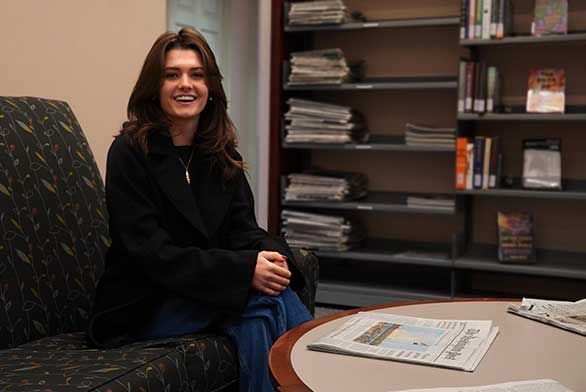
Meredith Reid (A29) never grows tired of listening to the array of vibrant conversations occurring on the campus quad in Annapolis any day of the week. Her homeschool background fostered a love for self-directed learning, and now she gets to share that same curiosity with a community of learners that enjoys asking questions as much as she does.
Between its two campuses in Maryland and New Mexico, St. John’s College annually attracts at least double the percentage of homeschool applicants that other colleges do. Independently educated students at St. John’s comprise between 4 and 10 percent of each incoming class. In contrast, fewer than 2 percent of students at the majority of higher learning institutions hail from homeschool backgrounds.
“St. John’s draws students who think consciously about the nature of their education and who are willing to take less-conventional paths,” says Benjamin Baum, Vice President of Enrollment at St. John’s College. “These are qualities highly correlated with homeschool students who, alongside their families, have built their own curricula.”
Baum also notes an ongoing growth of homeschool programs inspired by the classical education movement. For students who experienced this type of curriculum, a place like St. John’s can feel like a natural continuation of their education.
“Homeschool students add new perspectives around the seminar table, and bringing those varied voices to St. John’s is part of our mission in Admissions,” Baum says.
Reid, whose father has been in the military since she was a child, was fully homeschooled from kindergarten through high school through Classical Conversations, a parent-led Christian program rooted in the classical trivium model of grammar, dialectic (logic), and rhetoric. She discovered St. John’s College as a teen after her father was stationed at the Naval Academy: going for a walk one day, she recalls, she “stumbled into St. John’s, and it was this magical place.”
Having received a classical education for most of her life, Reid was unsure if she wanted to continue that path. Then she started attending Friday night lectures, which are open to the public, and was struck by the discourse she encountered amongst Johnnies. “They were so open-minded, so intelligent, so clear about what they were saying,” Reid says. “I was like, ‘I think I want to be like that.’ I was inspired.”
After years of schooling alone or in very small groups that often consisted of peers from Christian or military backgrounds, Reid loves learning alongside peers hailing from diverse walks of life. “We have so many different international students. We have so many different religious ideas, so many different philosophical ideas and backgrounds,” Reid says. “The group is so diverse; I’m getting a completely different perspective.”
Reid deeply appreciates the community she’s gained through the college, characteristically describing its intimate size as a “golden ratio.” Said community isn’t limited to peers her own age: At St. John’s, students discuss texts with their teachers as equals around a table, and Reid values the personal connections that can arise from these encounters. “The student-to-teacher ratio is just phenomenal,” Reid says. “A lot of times I feel like a little fish in a little pond, and sometimes I feel like a big fish in a little pond. I never feel completely lost.”
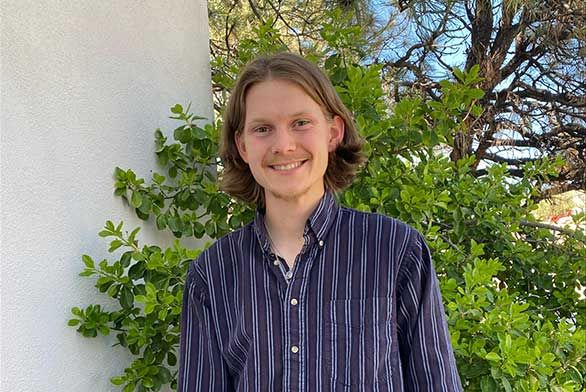
Like Reid, fellow homeschooler Evan Shortridge (SF26) does not take the community he’s found at St. John’s College for granted. “There was an aspect of learning that was sort of missing that I feel like has really been fulfilled at St. John’s,” Shortridge says. “I’ve learned how to talk about these texts—not just one-on-one with my teacher, but with a group of people.”
Shortridge was nearly entirely homeschooled from eighth grade onward due to family travel and the COVID-19 pandemic. He discovered St. John’s while flipping through a book of colleges with his parents; he was hooked after seeing that the New York Times had once dubbed it “the most contrarian college in America.” Prior to that, he recalls feeling disillusioned by his other prospective higher education options. “I really wanted to keep getting educated because I love learning,” Shortridge says. But, he adds, “I was uninterested in the lecture hall. I didn’t want to sit and have somebody tell me what the truth was. I wanted to figure out what the truth was.”
Shortridge can pinpoint certain similarities between his homeschool curriculum and the St. John’s Program, including one-on-one examinations with educators, essay responses to reading assignments, and an emphasis on self-directed learning. Shortridge also appreciates St. John’s refusal to partition the world into siloed academic disciplines, as a variety of topics and activities captured his attention while homeschooled. For example, he was able to take philosophy two years in a row while exploring other subjects such as anatomy and physiology.
Plus, he adds, “the St. John’s-style conversation has been super helpful for any kind of dialogue. Especially, you know, political, civic dialogue, even with people who disagree with you … We disagree? I have a massive respect for you anyway. And I think that that is not as much present in the world, which is why we need more Johnnies.”
Shortridge, who graduates this spring, believes that a St. John’s education has also become an even stronger asset in the era of AI. With many jobs, “you’re learning how to use all of these tools to solve this particular set of problems, and I think AI is getting better and better at doing that kind of thing,” Shortridge says, mentioning specific career paths and college majors that have quickly been destabilized amid technological advances. “I think that employers everywhere in every field now—even fields that require specialized knowledge—are [increasingly seeking] people who understand how the world functions at large, and who are able to solve problems and think critically about any subject.”
For Shortridge, St. John’s serves as not just a welcoming home base for former homeschool students but as a springboard for any path he wishes to pursue going forward.
“It was one of the best decisions of my life to go to St. John’s, because I feel like I can engage with frankly anything now,” Shortridge says. “It’s also fostered a really intense curiosity in me that was present before but has definitely been bolstered.”