
Author Roseanna White (A04) Explores the Books the Nazis Didn’t Burn
April 10, 2026 | By Jeremy Richter (A28)
On June 14, 1940, the Nazi Wehrmacht occupied Paris. For years, countless German dissidents had sought refuge from Nazism in Paris—a city famous across Europe for its reputation as a haven for people persecuted for their identity or beliefs. These dissidents brought with them books that had been blacklisted by the Nazis and were often burned in public squares. Together, they established a “library of burned books” made up entirely of titles that were forbidden in Germany.
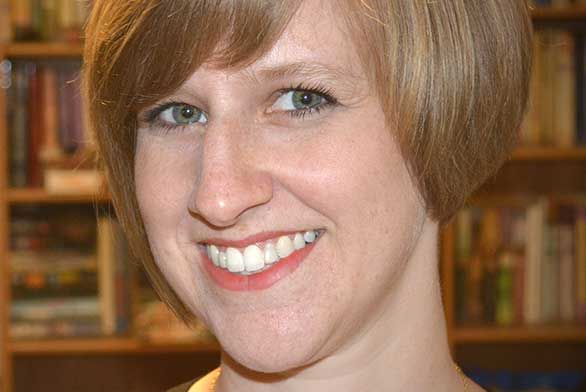
When the Nazis took Paris, the French government reportedly handed over the library without a fight. But rather than burn its contents, as Nazis routinely did with other so-called “degenerate” books and works of art, officials kept them under lock and key for the duration of the war. This secret library captured the imagination of Johnnie alum and award-winning Christian romance author Roseanna White (A04), whose latest novel, The Collector of Burned Books, explores the importance of free speech through a distinctly Johnnie lens.
The Collector of Burned Books is a historical romance set around the library during World War II. The book’s fictional heroine, Corinne Bastien, is a professor of philosophy at the Sorbonne. “She’s one of the very few female professors at the time,” White explains of her character, “and she’s running her class how Johnnies run their classes—she’s engaging her students, having them ask questions. And that gets dangerous when she has Nazis observing her classes. So, she has to decide, is this something we still do when we have people watching? And when she decides that it is, that gets her in trouble.”
White’s other protagonist is Christian Bauer, a German professor who secretly despises the Nazis but is forced into uniform by Joseph Goebbels to handle the “relocation” of France’s libraries. In Paris, he and Corinne try to protect whoever and whatever they can from destruction, including the ideas that will persuade ordinary people to fight the Nazis and help the Germans heal after the war.
White, who is Catholic, was strongly influenced by her faith when she wrote The Collector of Burned Books. Corinne and Christian are Catholics in an “incredibly secular society,” she says, who together view the Nazis as invaders—not just in France, but in Germany too. White remembers enjoying the process of writing “through the Catholic perspective that we unite our suffering with Christ.” Through the character of Corinne, she explores the nature of suffering, asking how Catholics can “love their enemies when the enemy is a Nazi standing at the door.”
As the Nazis become more aggressive, Corinne’s faith becomes even more important. “There’s a very dramatic scene where someone is shot, and Corinne’s first thought is to pray the Hail Mary because it ends with ‘in the hour of our death,’” White reflects. “That’s something that is always in the Catholic mindset. Death and suffering are a part of faith.”
While researching The Collector of Burned Books, White confronted the long history of book banning. She recalls, “As I really dug into this, I realized how timeless of an issue this is. In the Book of Acts, we even have accounts of new Christian converts bringing their ‘bad books’ and burning them in the city square. Today, we’re seeing so much book-banning in the U.S. and around the world. It’s getting worse because we’re afraid of ideas—and rather than say what we like and don’t like about certain ideas, which is what we do at St. John’s, we are saying that we just won’t engage.”
Looking back on her time at St. John’s, White is grateful for every Program book she read, including the ones she disagreed with. She readily admits to “not being a big Kant fan,” and recalls having been “appalled” by Nietzsche’s Beyond Good and Evil. But even in Kant and Nietzsche, White acknowledges she found “kernels of truth” that have stayed with her ever since.
She says, “There’s always something in every book we read that we can agree with. When I learned to come from that perspective of looking for the things that you can agree with, for the common ground, and for the things that make you think, I learned to value anything that I read. And that’s what I love about the St. John’s education—you read texts that are wrong and texts that have been disproven because they are a key step along the process to where we are now. You can’t understand where we are now until you understand where we’ve been.”
White’s message is resonating with people: in a widely read 2025 interview for Psychology Today about The Collector of Burned Books, she argued that reading “dangerous” books is essential for personal development.
White, a lifelong writer, notes that “writing is how I process.” She wrote seven books at St. John’s, although only one of them, a Biblical fiction entitled A Stray Drop of Blood, was published. Since then, she has published 50 novels and co-founded WhiteFire Publishing with her husband, David White (A04). To date, WhiteFire has published hundreds of books in the genre of Christian fiction.
To aspiring Johnnie authors, White’s message about the St. John’s Program is clear: “You can bring your St. John’s education into absolutely any genre—fiction, nonfiction, popular, high literary—whatever it may be. The lessons we learn at St. John’s transcend genre, and they are useful no matter what it is you’re writing. I can write about a chemist during the Revolutionary War era because I’ve read Lavoisier, and I can write about linguists because I did four years of language.”
When asked to name one controversial book that should be on every college student’s reading list, White chose Mark Twain’s The Adventures of Huckleberry Finn, which juniors at St. John’s read for seminar at the end of the year. “That book has been banned a lot, and it’s being banned again now,” White says. “But it needs to be read because it’s brilliant and it’s engaging. Twain has this way of showing evil through ridiculousness, and he encapsulates the time that he’s writing about while showing the flaws in it.”
White has no plans to stop telling stories that entertain readers while provoking them to think deeply about issues that matter: this July, she will publish another World War II novel, The Spy Keeper of Marseille, based on the real story of the woman who led the French Resistance’s largest intelligence network and helped turn the tide of war in Western Europe.