
Books Without Boundaries: How Yonghwa Lee (AGI01) and Kyoung-min Han Are Helping the St. John's Program Go Global
December 12, 2025 | By Kirstin Fawcett (AGI27)
August 2025 marked a full-circle moment for Yonghwa Lee (AGI01) when the Graduate Institute alum returned to Annapolis as a visiting tutor for the fall semester. But Lee, who is a professor at Incheon National University in South Korea, had also come to St. John’s College with his wife, Kyoung-Min Han, to learn—not just about the Great Books, but about teaching them.
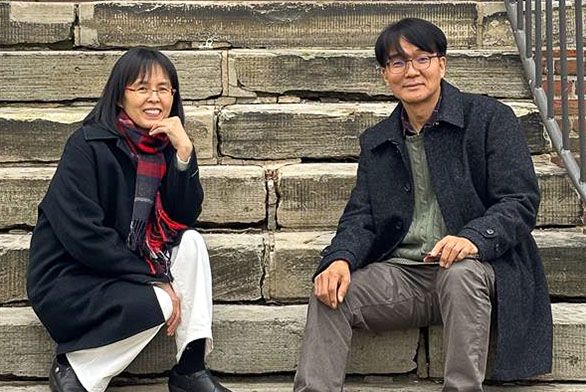
Lee and Han met as PhD students studying nineteenth-century literature at the Ohio State University. In recent years, the two college educators have laid the groundwork for a rapidly expanding all-ages Great Books movement in South Korea inspired by the Program. Through international collaborations with St. John’s and experimenting with homegrown discussion groups in local cities, Lee and Han hope to develop and promote a method of liberal arts learning that transcends age, continents, and cultures.
“I really believe that St. John’s needs to cultivate wider networks around the world—and not simply because it would be beneficial to the college,” Lee says. “This kind of education,” Han adds, “is too good to just stay here.”
St. John’s College has long counted numerous South Korean international students and alumni among its ranks, but the school’s presence there really grew post-pandemic after St. John’s learned of Lee and Han’s efforts. This spurred a flurry of reciprocal exchanges between the school’s Annapolis and Santa Fe campuses and the Korean city of Chuncheon, where Lee and Han live and conduct much of their outreach.
Last summer, following an expansive six-week summer trip to Chuncheon in 2025 undertaken by tutors Emily Langston, Aaron Halper, Nathan Shields, and others, Lee and Han decided it was their turn: Come fall, they would head westward to Lee’s alma mater and spend half a year observing Johnnie-led tutorials and seminars. Their goal? To glean new and useful takeaways for teaching across disciplines while continuing to engage students through the text—and with each other.
Lee and Han not only work with undergraduates but are the parents of two teenagers, one of whom is currently a first-year student at St. John’s Annapolis. As parents and educators, they believe that the college’s collaborative approach to liberal arts learning serves as an antidote to a national youth education model in Korea that's characterized by rote memorization, high-stakes standardized testing, and notoriously competitive college admissions. The widespread adoption of large language model technologies like ChatGPT has only strengthened their conviction, even as it increasingly makes them outliers: colleges in Korea “love that college students are using AI, as they are trying to introduce AI and how to make use of it,” Lee says. “As a result, they don’t talk about the importance of reading and critical thinking skills” as a necessary prerequisite for being introduced to AI.
Lee’s sense of urgency compelled him to propose the idea of an interdisciplinary Great Books Center to his INU colleagues. It launched in 2019 and provides students with opportunities to partake in collaborative seminars on authors ranging from Plato to Dostoyevsky to Marx. Soon after, Han paved the way for a similar institution at Hallym. A third Great Books Center at Kwangon National University, which has a campus in Chuncheon, is also in the works.
Lee and Han have also stepped outside academia in their mission to bring St. John’s to a wider audience, partnering with the City Education Office in Chuncheon to instruct teachers from kindergarten through 12th grade in how to conduct a St. John’s-style seminar. “Our immediate concern is to train the schoolteachers, so they can spread the pedagogy,” Han says. Through them, future generations reap the benefits of discussion-based liberal arts learning long before entering college.
Outside the classroom, Lee and Han host community seminars for lifelong learners at public libraries and through an interactive, liberal arts-themed summer camp in Chuncheon. They do this with the understanding that close reading and critical thinking are skills to be honed across one’s lifetime, regardless of age, background, and educational access.
At all levels, Lee and Han have mainly focused on adapting and implementing the seminar model. Korean society—from boardroom to classroom—is hierarchical, and courses are typically taught lecture-style. It took time to troubleshoot difficulties as participants adjusted to conversing as equals and embracing the idea of a text yielding multiple answers instead of a single “correct” one. Now, with several years of seminar officially under their belts, Lee and Han plan on eventually adapting the St. John’s tutorial to their arsenal while continuing to perfect the former. “To have a true understanding of the St. John’s model,” Han says, “you need to take various classes—not just seminars—across various disciplines, including math and natural sciences.”
Lee’s observations of St. John’s pedagogy have primarily been through being in the tutor’s shoes at St. John’s instead of in the student’s seat. He has spent the past semester teaching freshman seminar and guiding his cohort through works ranging from the Iliad and the Odyssey to Plato’s Republic. “There seems to be some shared consensus about how a seminar should be conducive to questions instead of trying to reach a certain conclusion,” he reflects. “To raise as deep questions as possible, and to encourage students to explore different perspectives while interacting with each other. This deepens their understanding of the text and the topics. In most cases, a good seminar will end up posing more questions.”
Han, meanwhile, has been a Johnnie fly on the wall, auditing undergraduate and graduate courses ranging from math and science to music. While tackling new ideas from the likes of Euclid and Lobachevski, she has taken notes on the structure and style of tutorials and how they compare—and contrast—with seminars. The most discernible difference, she concludes, is the tutor count; two are tasked with running an undergraduate seminar, while just one leads tutorial, a small change that results in a vastly different group dynamic. “When there are two tutors, and there are students, it’s people from all directions going back and forth. If there is one tutor, that tutor becomes the center,” Han says.
“In seminar,” she adds, “it’s also really hard to say that there are correct answers. You might say, ‘Oh, there might be a different way; the possibility is open.’ In math, in music, there is more direction,” in terms of material and conversation. In Han’s eyes, the tutorial model lends itself best to certain disciplines, like biology and math and music, while seminars are ideal for “conveying semantics” in works of philosophy, literature, and theology.
But even though tutorials are technically instruction-based, they’re still participatory, not to mention interdisciplinary. “In my math tutorial, the tutor asks all kinds of philosophical questions as well as really specific questions about the theorems,” Han says. “They’re all different, but they go perfectly well with each other. I think that really shows the essence of a St. John’s education. The most essential questions concerning humanity are being dealt with in different ways, across many different subjects.”
Lee and Han are slated to return to South Korea following the semester’s end, but they’ve just started sharing the St. John’s Program in all its complexity with their colleagues, students, and peers. Moving forward, they posit that we’ve only begun learning from each other: St. John’s, for example, could emulate their all-ages public outreach efforts in Chuncheon while sending Johnnies to Korea to observe how the Program operates across languages and cultures. The global future of liberal arts learning is a text that’s still being written, and its advocates in Korea, Annapolis, and Santa Fe are all co-authors in its story.