
Student Band Summerfield Builds Community Through Music in Annapolis
December 19, 2025 | By Utsuk Upreti (A28)
Winter unofficially arrived on St. John’s Annapolis campus to the tune of students humming along to the melodies of Summerfield, a folk musical duo comprising Helen Wagner (A26) and Wylie Robbins Thorne-Thomsen (A26). The two recently celebrated their new full-length recorded album, Like an Old Friend, which premiered with a live performance in the Great Hall during the final weekend of the 2025 fall semester.
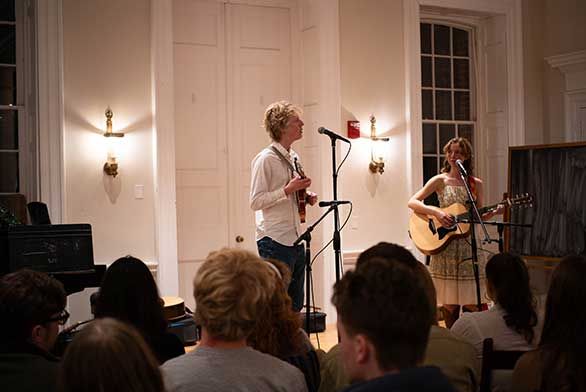
Wagner and Thorne-Thomsen met as classmates during their freshman year and bonded over a mutual love of music, which culminated in their playing, writing, and performing together as a band for the past three-and-a-half years. “I write the songs, and he makes them sound amazing with his instruments,” Wagner says.
Thorne-Thomsen plays the banjo, mandolin, and guitar, and sings harmonies with Wagner, whose own guitar anchors the vocals. Amid the daily rhythms of the Program, the two prioritize their shared side project by rehearsing between classes, playing for other Johnnies, and crafting their recordings entirely on campus. It’s “pretty special,” Wagner notes, that their latest album—the duo’s second and the third she’s personally worked on—marks the climax of her musical experience at St. John’s in 14 tracks.
The band name “Summerfield” references Wagner’s own middle name, which she traces back through a family lineage rooted in Maryland. Upon arriving at St. John’s, she discovered that said name also carries a historical connection to the college itself—one she encountered unexpectedly while studying in the common room of Edensword Hall, when she noticed a plaque dedicated to a Summerfield Baldwin. Giving that name to a Johnnie musical project felt like a fitting return.
At the same time, Wagner found herself venturing into unexplored territory with Summerfield. She has been writing songs since her early teenage years and even released a solo album during her junior year of high school, which she recorded with a recruited background band. But she had never experienced what she refers to as “true creative collaboration” until meeting Thorne-Thomsen; before that, she had ”just kind of played in my room by myself.” Thorne-Thomsen slowly transformed that room into a shared space, one that came to include a designated audience—a tight-knit circle of Johnnies and friends who sing along and “know the words,” Wagner says with a smile. These intimate performances, frequently held by moonlight by the McKeldin Planetarium or in the Great Hall, have showcased her growing confidence and imagination.
Engaging in these shows with Thorne-Thomsen throughout her time at St. John’s has changed Wagner’s approach toward making music. “I much prefer it now to playing alone,” Wagner reflects. “One of my favorite things about music is the relational aspect, and so sometimes when I play a solo show, it feels like there’s something missing, because what Wylie and I can create together is much more special to me.” Their partnership developed naturally through long evenings of playing together, experimenting with harmonies, and discovering how their voices and instruments complemented each other. “Getting to know someone as a musician is a very particular way of knowing them,” Wagner says.
This shared musical understanding quickly became central to Summerfield’s sound, and by sophomore year, their playing together was a regular occurrence. Wagner recalls one evening on the top floor of Pinkney Hall, two floors above the dorm room where Jac Holzman (Class of 1952) founded Elektra Records, when a group of friends gathered along the stairs with pizza in hand. She picked up her guitar, and Thorne-Thomsen joined in on the banjo; soon, everyone was singing along to old folk songs. “We’ve had lots of moments like this,” she says, “but I just remember this specific one.”
That same year, Wagner and Thorne-Thomsen recorded their first joint album, I’d Rather Be Laughing than Singing the Blues, with friend and fellow student Ranger Kasdorf (A24) overseeing production in Mellon Hall’s new music rehearsal room. The album captures the intimacy, collaboration, and joy that characterizes Summerfield at present, complete with album art printed and developed in the campus darkroom and a release show at McDowell Hall. “It was a very St. John’s project,” Wagner says.
Folk music, for Wagner, is less of a genre than a method of connection. She is drawn to its narrative clarity and sparseness of structure, which allows songs to be easily shared, remembered, and sung together. “There’s a certain simplicity to folk songs that makes them accessible,” she explains, noting that traditional music can draw individuals into a community by instinct. This accessibility also leaves room for imagination: many of Wagner’s songs unfold as fictional narratives rather than autobiographical confessions, populated by characters who carry emotional weight without demanding resolution. In this way, Wagner understands folk music as both a storytelling tool and a social tool, defined as much by collective participation as by solo listening.
This understanding of folk as a shared narrative reaches fruition on Like an Old Friend. Its writing ventures even further into narrative terrain, bringing together ideas and approaches that emerged across earlier works. The album includes songs written during separate periods, some of which remained unrecorded for years and others composed more recently. Wagner describes writing these “story songs” as a distinct creative experience, one that permits her to “exercise [her] imagination in the way that a fiction writer exercises their imagination.” She populates them with characters whose stories unfold across verses and projects.
“The Canyon,” a track from the new album, is the continuation of a tale first introduced in “The River” from the duo’s earlier record, I’d Rather Be Laughing than Singing the Blues; it traces the aftermath of two lovers who run away together. Elsewhere on the recording, songs like “April,” “Oregon,” and “Devil’s Game” take shape as vignette-like scenes, drawn from what Wagner describes as “encounters with various people” and rooted in observation and embellishment.
Another prominent recurring album theme is Wagner’s engagement with faith and spirituality. Several tracks from Like an Old Friend, including “Devil’s Game,” “Madonna of the Chesapeake,” and “In Virgie,” explore the tension of wrestling with organized religion alongside one’s own personal belief in God. Wagner attributes some of this perspective to her experience at St. John’s, where texts and authors in the sophomore year curriculum, such as the Bible, St.Augustine, and Thomas Aquinas, prompted deeper intellectual and spiritual reflection. Her songwriting, she explains, becomes another way of working through that relationship, translating questions of faith into music that is contemplative and expressive.
It is not a coincidence that the heart of Summerfield began beating stronger in Wagner and Thorne-Thomsen’s sophomore year. At St. John’s, that year marks a shift from introductory musical instruction and collective singing to a more sustained inquiry as students explore music theory, structure, and meaning. This shift mirrors the duo’s own intensifying collaboration and artistic direction.
Wagner also embraces a distinctive approach to tone, pairing weighty or difficult subject matter with musical levity. “I like writing lighthearted songs, even if they’re about heavy things,” she explains, describing her approach as a way of elevating tragic, unsettling, or otherwise “ugly” experiences into something structured and beautiful. For Wagner, the formal elements of music—key, structure, rhyme, and melody—provide a framework that transforms raw emotion into a sense of completeness. Within that, she deliberately infuses playfulness, creating songs that engage listeners while grappling with weighty themes.
Setting out to record a second and final album before their 2026 graduation, Wagner and Thorne-Thomsen produced Like an Old Friend last summer over three intensive days in the Mellon music rehearsal room, where they spent roughly 12 hours recording daily. Wagner’s younger brother, Harrison, flew in from Houston to record the album while friends from St. John’s, including Maya Dickerson (A26), Louise Harden (A26), and Josh Flippo (A26), contributed instrumental and vocal performances. Wagner herself painted the album art in Mellon Hall’s art studio, completing another layer of the project entirely on college grounds.
One particular performance from her student days stands out to Wagner: a crowded house show during her junior year, held in a friend’s basement during St. John’s croquet weekend, where Johnnies packed the room and sang along to Summerfield’s songs. It’s a vivid example of the musical community at St. John’s—“one example of a much bigger phenomenon,” as she put it, which extends beyond campus and into Annapolis, a city with its own vibrant open mic and concert scene.
As graduation approaches for Wagner and Thorne-Thomsen, Like an Old Friend feels like the end of a distinct chapter. Wagner sees Summerfield as a flexible concept shaped by the people she plays with, even as Thorne-Thomsen remains central to its sound. While she is unsure where she will wind up after college, she knows she will continue writing and sharing songs. Summerfield’s form may evolve, perhaps toward new collaborations—including work with Wagner’s younger brother—but the driving impulse remains the same. “I’m going to miss this version of Summerfield a lot,” she says. “It’s been a great four years.”
Listen to Summerfield’s album Like an Old Friend on Apple Music, Spotify, and YouTube.