
St. John's Annapolis: The College Where Student Translations Become Campus Bookstore Bestsellers
July 15, 2026 | By Jeremy Richter (A28)
St. John’s College is known for producing more humanities PhD candidates per graduate than any other college in the country, and for an unbroken streak of graduates accepted to law school dating back to 2012. Lesser known, perhaps, are the impressive foreign and ancient language skills acquired by many throughout the Program.
All undergrads must study two languages: four semesters of ancient Greek and four of French. Through the language tutorials, they read texts in their original state while gaining insight into the process of translating a passage. Some Annapolis Johnnies have even taken their abilities beyond the classroom—and into the St. John’s College Bookstore—by translating entire works into modern English and making them available for purchase on campus.
Required texts for St. John’s language tutorials include Greek titles such as Plato’s Meno and Sophocles’ Antigone, and French plays like Molière’s Le Misanthrope and Jean Racine’s Phèdre. Perhaps because it’s the first new language in which they gained reading proficiency as college students, multiple Johnnies have published full-length translations of ancient Greek tragedy and philosophy.
Liam Hansen (A26) translated Epictetus’s Handbook between January and March of his sophomore year. By the beginning of his junior year, print copies were available for purchase in the St. John’s College Bookstore through a special collaboration with manager Melinda Rooney (A84).
According to Rooney, the practice of publishing and promoting student translators at St. John’s Annapolis began several years back when student Henry Hills (A25) approached her with completed translations of Program titles from the Book of Genesis to Plato’s Ion. “What would be involved in having the print shop prepare copies to sell in the bookstore?” he asked.
Rooney loved the idea, and she began funding the publication of student translators through the St. John’s College Print Shop in Annapolis. “It’s not a profit thing for me. It’s just helping students interested in having their stuff published. It’s a real boost for them,” Rooney says. “You’re not going to go to another liberal arts college and walk into the bookstore and say, ‘Would you be willing to sell my translation?’ You’re not going to get that anywhere else.”
Hansen says he initially struggled with ancient Greek, and he credits the eventual strides he made to tutor Katie Kretler’s method of closely parsing text. “I was not a Greek whiz kid ... I found it pretty tough,” he reflects. “I just did it because I wanted to do it. There are 57 entries in [Epictetus’ Handbook] and about 58 days between winter break and spring break, so I tried to do one per day.” After completing this project, Hansen went on to translate the Principal Doctrines by Epicurus and portions of the Odyssey.
Student translator Davin Faris (A28), meanwhile, took quickly to ancient Greek. Following his freshman year, he decided to translate an entire Greek play over the summer. Faris eventually settled on Euripides’s Hecuba, which, unlike other works by the playwright, such as Medea or The Bacchae, is not included on the St. John’s College Program reading list. “I like Euripides a lot. He’s one of my favorite playwrights that we read, and I found the story of Hecuba really compelling and complex,” he says. Copies of the translated play were being sold in the bookstore by the following fall semester.
Learning Greek, Faris says, was more like “solving a puzzle than learning a language as I had experienced it previously. And for me, that kind of mindset made it very enjoyable.” He was also fond of language tutor Aaron Halper’s approach: “[Mr. Halper] wanted us to outline a section or a quote—to recognize the words and identify them loosely but not fully, so that we could sight-translate in class.”
Hansen and Faris share their enthusiasm with other Johnnies, such as Max Dreyfuss (A26), whose full-length translation of Plato’s Apology is also sold in the Annapolis campus bookstore. Still, the two hope that more students will take up the discipline outside of the classroom. “The point of St. John’s is trying to study the words of these authors as closely as we can,” Hansen says. “But you can only read a text as closely as possible if you have some understanding of the original language.”
Channeling essayist Walter Benjamin’s The Task of a Translator, Faris reflects that “the value of translating a text is, foremost, for the translator,” he says. “It’s getting to see an aspect of a work that is inexpressible in any other language … It forces you to ask yourself as you’re translating, ‘What do I want to draw out and what do I want to suppress? What do I want to reveal? What do I want to ignore?’ I think that’s a really compelling experience.” As he prepares to take French, he encourages underclassmen to enter the Annapolis campus’s annual Greek translation competition, which Faris won in his freshman and sophomore years.
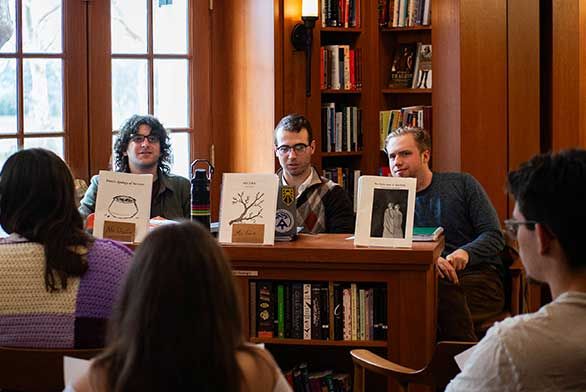
In April 2026, the St. John’s College Annapolis Bookstore hosted a round-table panel on the art of translation featuring Hansen, Faris, and Dreyfuss. The three of them delivered remarks, fielded questions from the audience, and translated passages in real time. Events like these foster student dialogue—and they’re also good for resumes. As college students across the country face increasingly competitive graduate school admissions cycles, Rooney emphasizes that translation is one way for Johnnies to differentiate themselves. Invoking Faris’s translation, which achieved “bestseller” status on campus, she says, “You could say that you’ve completed a translation of Hecuba that was a bestseller at the St. John’s College Bookstore. I think an interviewer would be pretty impressed, even for law school.“
For Hansen and Faris, the best answer to the question “Why translate?” seems to be the simplest one. Translation, as Faris says, “expands the view that you have of a work.” Hansen, for his part, says he now often finds himself thinking about the significance of words in different languages. His favorite Greek word is nostos, meaning homecoming.
“Ancient Greek had a single word for [homecoming],” he says. “You read it and realize this was very important to their culture.” For Johnnies, who spend four years translating ancient and modern texts into English, the word likely feels apt as they prepare to tackle whatever comes next—whether in graduate school or somewhere else.