
Four Founders, Two Residence Halls, One Complex History
July 1, 2026 | By Whitney Bixby (A25)
As the United States of America commemorates the 250th anniversary of the signing of the Declaration of Independence, St. John’s College has taken the time to reflect on its own early years, which prominently overlap with the lives of several historic Maryland residents who signed the nation’s landmark founding document. Two historic residence halls at St. John’s College Annapolis—Paca-Carroll House and Chase-Stone House—are named after four Founding Fathers: William Paca (1740-1799), Charles Carroll of Carrollton (1737-1832), Samuel Chase (1741-1811), and Thomas Stone (1743-1787).
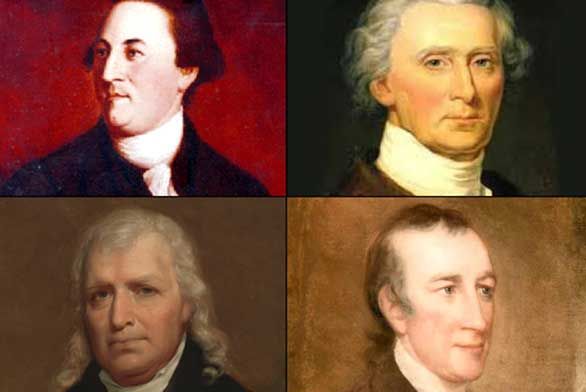
Leading up to the signing of the Declaration, these Maryland signers advocated for the American Revolution, and for a world order based on the following “self-evident” truths: “that all men are created equal, that they are endowed by their Creator with certain unalienable Rights, that among these are Life, Liberty and the pursuit of Happiness.” Today, their legacies can best be described as complicated: despite championing universal rights for all individuals, the four men were also enslavers.
By following the story of the Revolution through Paca, Carroll, Chase, and Stone, we might come to a more complete understanding of the history of the St. John’s College Annapolis campus and its place in American history—a history that’s not always as triumphant, straightforward, or principled as we’d often like, even as we continue to learn from it.
William Paca (pronounced Pay-Kah) was born to prominent plantation owner, enslaver, and legislator John Paca in the region that would eventually be named Harford County, Maryland. Paca was nicknamed the “deliberator” by John Adams due to his skilled debate performance as a delegate for the First and Second Continental Congresses. The Annapolis-based lawyer, along with his good friend Samuel Chase, co-founded the Annapolis branch of the Sons of Liberty, the underground Patriot political group formed to protest British rule throughout the Thirteen Colonies.
Paca served as Maryland’s third governor from 1782-85, and he was appointed by George Washington to be a District Judge for the Court of Maryland in 1789. He died in late 1799 at age 58; his house in downtown Annapolis today serves as a museum and historic garden.
Regarding the “Carroll” in “Paca-Carroll,” it refers to Charles Carroll of Carrollton (not to be confused with Charles Carroll the Barrister, his cousin, for whom another campus building is named), who was the wealthiest and most prolific enslaver in the colonies at the time of the American Revolution. Perhaps paradoxically, he was an early advocate of American independence, publicly debating on the issue through newspaper articles and public forums.
A Roman Catholic of Irish descent, Carroll ensured through the Maryland Constitution that Catholics could participate in public life. (While Maryland had famously been founded in 1634 as a bastion of religious freedom, lingering political fallout from the 1689 Protestant Revolution meant that Catholics could not hold office nor vote.) Carroll served as a United States senator for Maryland from 1789 through 1792. He was the last surviving signer of the Declaration before dying in 1832 at the advanced age of 95.
Samuel Chase, of Chase-Stone Hall, was nicknamed “Demosthenes of Maryland” for his florid yet effectual prose. Chase worked as a lawyer in Annapolis and Baltimore, and he was known to be irascible and prone to debate; he became a representative in the Continental Congress and later served as an associate justice of the United States Supreme Court from February 1796 until his death in June 1811. His staunch Federalist advocacy and outspoken partisan opposition to Thomas Jefferson’s presidential administration led to him becoming the only Supreme Court justice in history to face an impeachment trial in 1804. He was acquitted in 1805.
In contrast to Maryland’s other three Declaration of Independence signers, Thomas Stone desired peace with Britain and was open to diplomatic relations. A lawyer and enslaver, Stone served as a Delegate of the Continental Congress and sat in on the committee that formed the Articles of Confederation in 1777, though he did not sign the actual document. Stone was elected to the Maryland Senate in 1779, but he withdrew from the public eye in the 1780s to care for his wife, whose health was declining. He died in 1787 at age 44, just several months after she did.
Thanks to the collective efforts of these four Declaration signers, the colony of Maryland eventually agreed to fight for independence. In the summer of 1776, with the Revolutionary War already underway, each of the young nation’s 13 colonies was forced to decide whether to separate from Britain. Initially, Maryland’s provincial government opposed separation and forbade its congressional delegates—which included Paca, Carroll, Chase, and Stone—from voting for independence.
In response, Paca, Carroll, and Chase whipped up a revolutionary campaign to garner the support of Marylanders. Their campaign convinced the provincial government to let the delegates cast their ballots for liberty. The delegates voiced Maryland’s decision on July 1, 1776, along with 11 other colonies, with New York being the only one to abstain from the vote.
Congress approved the Declaration of Independence on July 4, 1776. However, it was not until August 2 of the same year that the Declaration was signed by 50 of the 56 representatives. Despite Congress’s approval of the Declaration of Independence, the work was not over for the Maryland signers; on July 6, Maryland formally declared independence from Britain in a declaration primarily written by Carroll called the Declaration of Delegates of Maryland. It was published alongside the Declaration of Independence in the Maryland Gazette on July 11. Additionally, while Stone remained in the Continental Congress, Carroll, Chase, and Paca all returned to Maryland to help draft the state’s Declaration of Rights and Constitution.
Throughout these tumultuous years, St. John’s—then known as King William’s School—served as a communal hub for Maryland’s Declaration signers and their fellow Patriots. One famous meeting spot for the local Sons of Liberty chapter, founded by Paca and Chase, was beneath a large tulip poplar on the school’s front lawn that came to be known as the Liberty Tree. (Chase and Paca led multiple protests through the streets of Annapolis, including several protesting the Stamp Act.)
Maryland’s Declaration signers also played a key role in the college’s transition from King William’s School to St. John’s College. In fact, it was a result of Maryland Governor William Paca’s wish to improve education in Maryland that the charter for St. John’s College was enacted in 1784. To oversee the transition from King William’s School to St. John’s College, the formation of the Board of Rectors, Visitors, and Governors occurred, and it included these four men. Most contributions toward the new school were made by Carroll, Paca, and Stone, and St. John’s College effectively began operations in 1789. Which, of course, indirectly brings us back to the school’s historic residence halls: Paca-Carroll House and Chase-Stone House.
Erected in 1855, the Paca-Carroll House was originally a duplex, built to accommodate faculty and their families, and Chase-Stone House, built shortly after in 1857, served as housing for the St. John’s College president and vice president. In 1929, both were converted into fraternity houses, and the buildings bore the respective groups’ Greek names. It was not until 1939, when St. John’s College president Stringfellow Barr banned fraternities, that these residence halls were renamed Paca-Carroll House and Chase-Stone House.
As Johnnies, it is important to balance pride for our school’s rich history while acknowledging its darker nuances. Paca, Carroll, Chase, and Stone greatly contributed to American independence, paved the way for Maryland’s sovereignty, and enabled the formal establishment of St. John’s College. Still, we must also acknowledge that these men did not stand for the rights of all Americans by participating in and profiting from the institution of slavery, even while professing belief in the self-evident truth that “all men are created equal.”
We can look back on the United States’ past with an understanding of both the moral failings and historical importance of its founders, as the St. John’s College History Task Force recently did through investigating the college’s ties to slavery through its campus architecture. History isn’t always linear, and for that reason, it is important to retrace our steps—and our missteps—while striving to move forward.