

Louis Gonzalez (SFGI08) Circumnavigates the Globe in Round-the-World Sailing Race
June 22, 2026 | By Meliha Anthony (A25)
Louis Gonzalez (SFGI08) has spent much of the past year in the middle of the ocean with nothing but sky and sea for miles. “When you feel alone at sea, when there are no stars in the sky at night, and there are only big waves,” Gonzalez reflects, “you ask yourself a central question: ‘Who am I? Who do I want to be?’”
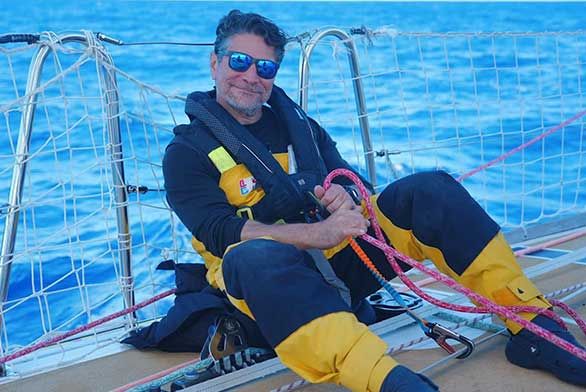
Gonzalez embarked in August 2025 on a journey to circumnavigate the globe on a 70-foot racing yacht, with little formal experience under his belt. He and his crew are now close to completing the Clipper Round the World Yacht Race, a 40,000 nautical mile-long competition between 10 identical yachts sailed by amateurs—as opposed to the world-renowned Ocean Race, which follows the same route but is intended for professionals, according to Gonzalez.
“Mother Nature does not discriminate against gender, age, or level of experience, so neither do we,” Clipper Round the World’s official website proclaims, with the assurance that race organizers will teach participants everything they need to know to be safe on the water. “This race is about human endurance,” Gonzalez adds. “It is about what we can really do when there is not a lot at our disposal.”
Gonzalez was briefly on dry land in June 2026 after decamping two months prior from Seattle to Washington, D.C., to complete the seventh portion of the eight-leg race. And, as fate would have it, his longtime partner, Phelosha Collaros (SF00), St. John’s Vice President for Board Governance and Strategic Outcomes, was concurrently in Annapolis for the college’s June board meeting and able to greet him at the docks. Now, Gonzalez is back on course and anticipates reaching the finish line in Portsmouth, England—the British Royal Navy’s storied home base and the race’s initial departure point—in mid-July.
An experienced ski patroller and avid enjoyer of outdoor sports, Gonzalez had long been interested in sailing and finally began researching opportunities in 2019. He soon discovered Clipper Round the World, and the landlocked New Mexico resident was immediately intrigued.
Gonzalez was accepted as a Clipper Round the World contender following the interview portion of his application—but then, the pandemic hit. He revisited the goal in 2025 and completed the requisite four levels of training over the course of a month before setting sail that August. “I felt like I needed to really be on this race,” Gonzalez says. “I kept going forward. I’ve wanted to quit so many times.”
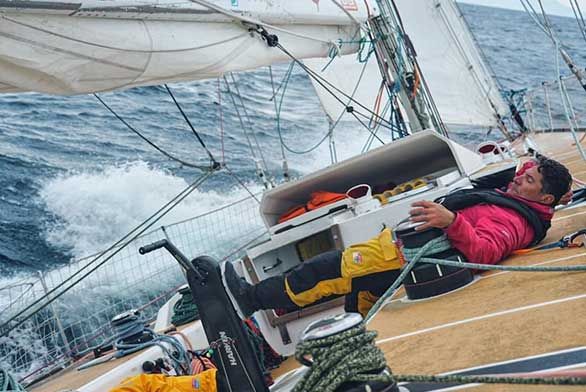
With a starting line in the U.K., the race stops in South America, South Africa, West Australia, East Australia, China, the U.S. West Coast, and the U.S. East Coast, with short breaks at each destination to recharge and explore before heading onward to England. Gonzalez had initially committed to just two legs—from England to South America and then on to South Africa—but he continued pushing himself and ultimately committed to the full experience.
Gonzalez, an Albuquerque-based educator with a Master of Arts in Liberal Arts from St. John’s Santa Fe, first experienced the school as an undergraduate. He wound up completing his bachelor’s degree at the University of New Mexico, but the St. John’s Program stuck with him, and he continued to read and study ancient Greek.
Gonzalez eventually returned to St. John’s Santa Fe in 2007 to pursue his master’s degree following a brief stint in the U.S. Army Reserve. He had realized while in the military that he wanted to become a teacher and work with youth from under-resourced backgrounds. In addition to teaching, Gonzalez has also worked as an instructional coach, a director of curriculum instruction and assessment, and a vice-principal. His experience with the St. John’s Program has served him well throughout his professional—and personal—adventures.
“A lot of my success I owe to my experience at St. John’s College,” Gonzalez says. “I’m always returning to the books [when] I’m faced with challenges in my life. So, the experience we have at St. John’s College never fully ends, even when you’re at sea.”
Fellow Johnnies have periodically asked Gonzalez throughout his voyage, “Who did you take with you?” They mean, “Which books do you take with you?” Homer and Nietzsche, according to Gonzalez, are the Program authors who have kept him going.
“Sometimes the seascape isn’t perfect. It’s dealing with towers of water, towers of sea, towers of ocean,” Gonzalez says. “It’s like what Odysseus went through … It’s coming face to face with yourself and who you are.”
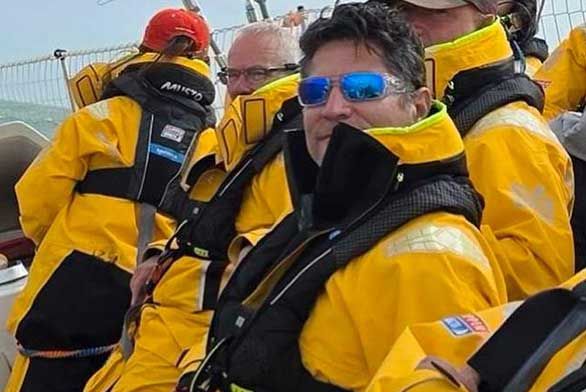
Early on, Gonzalez and his crew battled through the Bay of Biscay off the coast of France, an area that is intimidating to many sailors due to its infamously tumultuous waters.
While sailing during a storm, a crew member fell on deck and fractured his skull, and Gonzalez had to step in and help as the onboard medic and assist the skipper. The crew member was deemed safe after an emergency helicopter was called in, Gonzalez says, though he ultimately did not finish the race.
Another challenge Gonzalez faced was an unexpected death back on land. “I lost a beloved friend, family member,” Gonzalez says. “I was gonna miss her funeral, and I was gonna miss everything, and I felt for a minute there like I was imprisoned in the sea.”
For a moment, Gonzalez considered getting off the ship in South Africa and ending his trip early to grieve with other loved ones. He pushed through, though, realizing he couldn’t quit. Quitting at that moment, for him, would have been a betrayal not only of himself but of the person he had lost, whom he knew had wanted him to finish the journey.
Gonzalez and his peers have supported each other through highs and lows at sea. “Your crew becomes your family,” Gonzalez says. “When marriages break down at sea, when people die, and you can’t go home, when things happen, you turn to each other. You cry with each other in the sail locker; you laugh with each other. You celebrate each other’s birthdays.”
Birthdays are especially important, Gonzalez notes, because by dint of participating in the Clipper Round the World, each crew member takes a 50/50 gamble and risks life-or-death situations: “We pray that our tethers hold, we don’t fall in.”
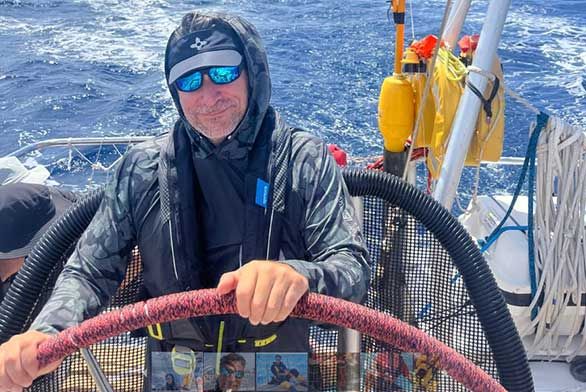
Now, as he gears up to finish the race’s final leg, Gonzalez grapples with what it means to return home. “I remember in seminar [after reading the Odyssey], I got the question, ‘What does it mean to come home?’ And that’s the question I’m dealing with now,” Gonzalez says. “Who will I be? I think I’ve changed immensely, and I think I’m very different. I think I can handle a bit more.”
After he completes Clipper Round the World, Gonzalez plans on returning to the classroom. “That’s my career; it’s what I’ve been doing for over two decades,” he says. “But I have other goals. I might sail the South Pacific at some point; I don’t know. Maybe go around the world again, in a different direction,“ he laughs. ”I’m going to keep sailing, that’s for sure. I’m gonna keep ski patrolling.”
After all, he notes, his life in the classroom and life at sea aren’t so different. The kids Gonzalez works with often “look for credibility” in their teachers—and “when you think about the hopelessness of being at sea in the middle of a storm,” he says, “I survived it. And if I can survive that, you can survive high school.”