
Back In Print: Annapolis Tutor J. Winfree Smith’s History of the New Program
June 12, 2026 | By Annie Frost (SF28)
A St. John’s Reporter article from February 1983 quotes alum Francis Mason (Class of 1943) saying of Annapolis tutor J. Winfree Smith: “It is a matter for universal rejoicing, I think, that he is the author of the history of the St. John’s program which is soon to be published.” Mason, himself a renowned New York author and dance critic, was referring to A Search for the Liberal College: The Beginning of the St. John’s Program. Published that September by St. John’s College Press, Smith’s highly anticipated retrospective of the New Program recalled Stringfellow Barr and Scott Buchanan’s dreams of reviving liberal education in America while chronicling the college’s evolution from 1937 through the early 1980s.
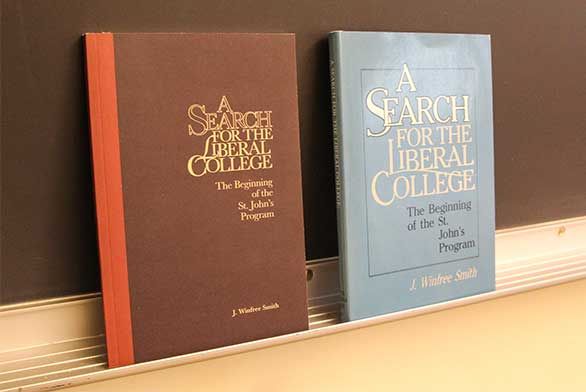
In celebration of the 60th anniversary of the Santa Fe campus in 2024, Smith’s 1983 book was reprinted for the first time in decades by the St. John’s College Press, a project led by Santa Fe librarian Jennifer Sprague. Today, this re-release feels timelier than ever as St. John’s Annapolis looks back at its own history amid the nation’s semiquincentennial while anticipating the New Program’s 90th anniversary in 2027.
An ordained Episcopal priest who actively served at the historic St. Anne’s congregation, Smith earned his bachelor’s and master’s degrees in history from the University of Virginia, as well as a PhD in philosophy from UVA and a master’s degree in divinity from the Protestant Episcopal Theological Seminary (today Virginia Theological Seminary). He joined the faculty of St. John’s College in 1941. Smith wrote essays and accompanying texts for Program readings, including a second-year math text titled Cartesian Geometric Algebra. The tutor was also loved for his sense of humor and theatrics; the Reporter article describes him as someone who always delivered “a certain sanity, a clarity, an openness, a kindly perspective,” and “unfailing courtesy” to anyone and everyone he happened to converse with.
Smith retired in 1984 but continued to teach at St. John’s on a part-time basis; in 1991, he passed away from a heart attack after serving the college for more than 50 years. His book lived on, however, even as copies became increasingly scarce.
Bringing it back to shelves in 2024 was an ambitious project for Sprague: Lacking digitized source texts for the book, its reprinting required scanning the original 136-page edition, with extensive reformatting and copyediting by Sprague to fix errors caused by the scans. She also verified and expanded Smith’s references by digging up old news articles and college documents. Now-retired Santa Fe librarian Craig Jolly assisted her in research, and graphic designer Melissa Latham-Stevens formatted the new edition.
Going back through the book’s references was no small task either. Smith had pieced together an astonishingly rich history of the college’s early years, pulling from official archives, meeting transcripts, recollections of those present at the founding, and personal correspondence, all sourced from the Annapolis library archives.
Smith had been a student of Barr and Buchanan’s at the University of Virginia, where the two professors had taught together; as a tutor, he worked alongside them in their roles as president and dean of St. John’s. Given these relationships, Smith was able to produce vibrantly written portraits of Barr, Buchanan, and other figures who contributed to the establishment of the New Program while rendering the courage and imagination required in their undertaking.
St. John’s College did not always offer the holistic education we know today: The school was founded in Maryland as King William’s School in 1696, and up until 1937, it closely resembled other colleges in many ways, offering specialized bachelor’s degrees during the time that Barr and Buchanan proposed a restructuring of its curriculum to the board.
At the time, the college had faced a variety of administrative issues throughout the prior decade and had lost its accreditation after awarding a degree to a student who had not met the requirements. This, as well as being on the brink of financial ruin, meant that St. John’s had as little to lose as it ever would, and the board agreed to give Barr and Buchanan the freedom they needed to institute the New Program.
Barr became the public-facing representative of the Program as he took on administrative and social duties as president, and Buchanan worked behind the scenes as dean, putting their vision of a Great Books-based liberal education to the test. The decision by the St. John’s board to allow Barr and Buchanan to attempt to bring it about was a radical one.
From the very beginning, Barr and Buchanan resisted categorizing the Program as “experimental,” believing they were restoring a tried-and-true method of education—and yet, in many ways, it relied on trial and error. In their opinion, there was no college in America at the time that embraced liberal education and sought to encourage free thinking in the way the founders imagined. Yet the project felt pressing, considering the state of international affairs: the growing shadow of fascism in Europe and the imminence of World War II emphasized the importance of deep rational thought and discourse on what makes a free and good society.
Barr and Buchanan’s unorthodox methods, which included dismissing specialization and holding exclusively seminar-style classes, placed huge demands on everyone involved, as Sprague emphasizes in an interview: “For instance, when they started the New Program, the faculty who were there were told, ‘This is what we’re going to do—and you have a choice of buying into this and being willing to teach across the curriculum, or of leaving to teach elsewhere.’ That whole notion that the faculty are expected to teach across the curriculum—the entire Program is radical.”
The expectation that faculty would be expected to teach across the curriculum vastly reshaped the St. John’s community; curricular decisions were not to be delegated to different departments but made by the collective faculty, creating an investment that nourishes the program and the community. As Sprague observes, “The fact that the entire faculty takes care of what is actually read, I think, is something that we take for granted.” (In many ways, this expectation extends to the students, who are asked to take on every area of the program with care and investment, creating a shared responsibility between them and tutors.)
Part of the joy of reading Smith’s history is not only understanding how various facets of the Program came about, but discovering the minds and often colorful personalities behind the ideas brought to life—such as Buchanan and his wholehearted dedication to the form of liberal education, which manifested itself in reading groups for faculty and their families, and lectures for the public. As Sprague says, Buchanan never stopped asking, “How do we make it so that people are going to have fulfilling lives, meaningful lives? How do you do that through education?”
The title of Smith’s book, A Search for the Liberal College, came from a long essay written by Buchanan on the undertaking to restore liberal education. Buchanan’s fierce commitment to this ideal was matched by his pedagogical talent and energy, described here by Smith: “He delighted in taking extreme positions, in arousing thought by making startling analogies from which he would draw the most far-reaching consequences, in trying to reconcile the irreconcilable … His penetrating look made one think he could see into one’s soul.”
Smith highlights Buchanan’s imagination and “characteristic flair for surprising suggestions” in the following passage:
“...he suggested that there should be at St. John’s an Institute of Cinematics which would be a research institute, separate from, but in close relationship with, the undergraduate curriculum, where movies would be made and ‘everything from the raw material, both animate and inanimate, to the finished movie performance, [would be] studied from both theoretical and practical standpoints.’ ‘The movies, he claimed, ‘put all the arts together. In some sense they offer the only major activity of modern civilization which properly and exhaustively mirrors the liberal college.’”
Perhaps Buchanan’s most surprising characteristic, as related by Smith in his book, was how little he was bound by the works he considered foundational to a liberal education: “In some sense, though it seems strange, he did not really respect the authors of the great books; that is, he did not think it of first importance to try to find out exactly what the authors meant.” Buchanan saw the Great Books as jumping-off points for thought; to him, the true fruit of seminar was not the interpretation of the texts, but the free exploration of ideas generated by discussions of them.
Meanwhile, Barr—whom his colleagues often called “Winkie”—was equally devoted to the search for a form of true liberal education. During the first few years of the Program, the college broadcast lectures and conversations from radio station WFBR in Baltimore, including 15-minute samples of seminar discussions. Some of these were given by Barr, who devoted no small effort towards explaining (and often defending) the New Program to the public, which included skeptical St. John’s alumni and other members of higher education.
In one such broadcast, Barr sought to dispel misconceptions of the Program by explaining what the St. John’s Program was not. The long list concluded by addressing a criticism still relevant today—that the reading list of the Program meant “turning away from contemporary America to the dead past of Europe.” Barr, in his broadcast, stated that the past of Europe is also the past of America, and that understanding our past is a part of understanding ourselves. He then went on to explain a deeper belief that underpins the St. John’s curriculum: “The great books,” Barr said, “are those that have ‘persistently remained contemporary;’ that is, they have to do with questions that belong to no particular time because they belong to all times.”
The modern relevance of the questions wrestled with by the ancient Greeks is perhaps nowhere more poignant in Smith’s book than in his description of the college under the strain of World War II, just a few years into the establishment of the New Program. Many students and faculty members left their studies to serve in the military—so many that during the war, the Class of 1944 dropped from its original number of 93 to only seven students who received their degree that year, though many returned after the war. Smith describes the ceremonies held by Barr and Buchanan for the departure of students who enlisted:
“During the 1942-1943 session there were two occasions when a solemn ceremony was held in the college’s Great Hall, and all those leaving for the war took the Ephebic oath administered by Barr. This oath was taken by Athenian youth as they were going off to war:
‘I will not disgrace the name of my country and I will not desert my comrades in the ranks. By myself and with my fellows I will defend what is sacred, whether private or public. I will hand on my country not lessened but greater and nobler than it was handed down to me. I will hearken diligently to those duly charged with judging, and I will obey the established laws and whatever others the people with common consent establish. And if anyone attempts to overthrow the laws, or not obey them, I will not stand idly by but by myself and with all my comrades I will defend the law. And I will honor the religion of my fathers. The gods be witness to these things.’
There were some who wondered how American youth could honor the religion of their fathers and at the same time call upon the Greek gods to witness their oath. But everyone felt the seriousness of the occasion. Some of the young men who took the oath were to give their lives in combat. Many were to follow Barr’s admonition, given on that occasion, not to forget in the midst of all the irrationality of war that there is still such a thing as human reason.”
Aside from the war, Barr oversaw the college as it navigated other great shifts during the first decade of the New Program, which included constant negotiations of administrative power and decision-making as well as an attempt by the U.S. Navy to claim the property of St. John’s Annapolis for expansion of the Naval Academy. Smith also wrote about the departure of Barr and Buchanan and the gradual stabilization of the college from its tumultuous early days, which were characterized by incessant changes to the curriculum’s reading list and seminar/tutorial model.
A third figure in Smith’s history is philosopher and Plato scholar Jacob Klein, who joined the Program as a tutor in 1938 and later served as dean for nearly 10 years. During Klein’s deanship, the curriculum gradually evolved to bear a closer resemblance to today’s Program. Smith documented cuts and modifications to the colossal reading list, the removal of Latin and German from the language program to allow students to master ancient Greek and French, the expansion of the music program, and many conversations surrounding the nature of the lab program, all of which would likely sound familiar to students and faculty today.
In his writing, Smith returns repeatedly to the question of the role of the past and of tradition in education; he prods us to remember that a successful institution of liberal education, one which seeks to free the human mind, must perform a balancing act between adherence to tradition and constant reexamination—a tension of which Klein was very aware.
Santa Fe tutor Frank Hunt (SF74), who, as part of the St. John’s College Press Committee, co-approved the reprinting of A Search for the Liberal College along with Annapolis tutor emerita Pamela Kraus, was a sophomore at Annapolis during Klein’s time as dean. He recalls in an interview that one of Klein’s lectures, entitled “Speech, Its Strength and Its Weaknesses,” was a formative moment in his academic career and sparked an interest that later led to graduate work in philosophy.
Smith, in his history, quotes a passage from the same 1973 lecture, in which Klein introduces philosopher Edmund Husserl’s concept of “sedimentation.” Klein explained that according to Husserl, words in their use naturally tend to lose their “original and precise significance” as they become more familiar, resulting in a vague understanding of our own language. “Yet that original significance is still there,” Klein said, “in every word, somehow ‘forgotten,’ but still at the bottom of our speaking and understanding, however vague the meaning conveyed by our speech may be.”
Smith, too, says in his book that Klein believed that one of the duties of the liberal arts is to counteract this process of sedimentation and forgetfulness—and he perhaps even saw his own work in writing A Search for the Liberal College as a measure against the sedimentation which occurs in an educational institution. In the closing paragraph of the book, he touches on this danger:
“Moreover, an educational institution, by its very nature, is concerned with the passing on of a tradition. Yet in the passing on of a tradition there may well occur, not so much the loss, as the concealment or the blurring of the insights that are at the roots of the tradition—what Jacob Klein described as sedimentation.” Reading Smith’s history is an act that resists the sedimentation of tradition by directly engaging with the ideas and people that have shaped the Program into what we know today. The routine of tutorials and seminars, the reading list, the lab experiments, and the project of a St. John’s education as a whole should not be taken up unquestioningly; Smith reminds us that the work of every student or faculty member lies not in the observance of tradition, but in the freeing of the human intellect.
Reprinted in 2024, A Search for the Liberal College: The Beginning of the St. John’s Program (1983) includes a new preface from President J. Walter Sterling. It can be purchased online or in person through our campus bookstores in Annapolis and Santa Fe.