
Tutor Harvey Flaumenhaft Revisits 'The Federalist Papers' Amid Nation's Semiquincentennial
October 1, 2026 | By Jeremy Richter (A28)
Harvey Flaumenhaft, currently the longest-serving tutor at St. John’s College, has always done things differently. That’s probably why he has stayed for so long.
In 1966, as a young instructor at Wheaton College in Norton, Massachusetts, Flaumenhaft refused to manage his government classes like most professors. For him, the seminar method was always the most natural way to advance learning. “Every semester,” he says, “I had to ask for a table to sit around.”
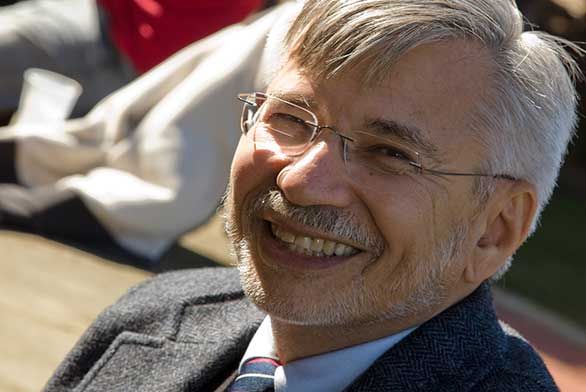
Two years later, Flaumenhaft’s wish was granted, albeit indirectly, when he secured a tutor position at St. John’s and moved to Annapolis. In his 58 years as a faculty member, he has served as dean of the college, a position he held from 1997 to 2005, and published or edited books on topics as wide-ranging as classical geometry, the politics of nuclear science, and the Founding period of American government.
Flaumenhaft’s most recent title, 2025’s The Framework of the Federalist: Visualizing the Structure of the Argumentation, analyzes the logic and rhetoric of “Publius”—the pseudonym for authors Alexander Hamilton, James Madison, and John Jay—to bolster support for a new Constitution. He is using the text as a resource this fall semester while leading his first-ever Graduate Institute class, a Federalist Papers preceptorial that coincides with the nation’s year-long observance of its 250th birthday.
Flaumenhaft, who grew up in Newark, New Jersey, was a member of the first-ever cohort of National Merit Scholars. He came to the University of Chicago knowing he wanted to work in the social sciences, most likely as a professor. In retrospect, he says he didn’t know that “reading the development of thought in the West was a major,” or else he might have chosen to study at St. John’s.
UChicago, to its credit, had its interdisciplinary Core Curriculum, which required students to take biological and physical science alongside coursework in literature, philosophy, and mathematics. The university had also been home to the Manhattan Project’s top-secret Met Lab research facility during World War II, and Flaumenhaft worked as an assistant editor on a book called The Atomic Age (1963), a compilation of essays and articles exploring the political and ethical implications of nuclear weapons.
After graduating in 1960 with a BA in political science, Flaumenhaft spent the following year as a Woodrow Wilson Fellow at Harvard University. He then returned to UChicago for a master’s degree in political science—this time around, as a NASA Fellow studying the intersection of government, science, and technology—before eventually earning his PhD.
It was back in Chicago, through osmosis, that Flaumenhaft learned about St. John’s College. Several decades prior, UChicago launched a Great Books-focused lifelong learning certificate program, the Basic Program of Liberal Education for Adults. It was set up by colleagues, friends, and students of St. John’s Program founders Stringfellow Barr and Scott Buchanan.
Upon hearing of St. John’s, Flaumenhaft recalls thinking, “Nowhere else would I get the chance to read these books.” After stints as a lecturer and instructor at Roosevelt University, UChicago, and Wheaton College, he joined the St. John’s faculty and embarked on the following six decades doing exactly that—for many years, alongside his late wife, Mera Flaumenhaft, a fellow UChicago alum who was hired by the college in 1977 and served as a tutor until 2018.
Flaumenhaft has spent a literal lifetime with the St. John’s Program, but he’s had ample opportunity to pursue his love of scientific and political philosophy with research grants and book projects. In 1984, for example, he was invited by the National Endowment for the Humanities (NEH) to join a planning committee exploring the connection between the humanities and the sciences. “I explained to them,” he recalls, “how [at St. John’s] we don’t draw a line” between the two.
Flaumenhaft suggested a project they should consider taking on, and the NEH invited Flaumenhaft to join said project as its general editor. It expanded into a multi-volume guidebook series, Masterworks of Discovery: Guided Studies of Great Texts in Science, published by Rutgers University Press. The first volume was St. John’s tutor Joe Sachs’s book on Aristotle’s Physics, which was followed by an overview of pioneering Austrian geneticist Gregory Mendel—the same year that Flaumenhaft’s PhD dissertation, “The Administrative Republic of Alexander Hamilton,” was published by Duke University Press as The Effective Republic.
In 2020, St. Augustine’s Press published Flaumenhaft’s Insights and Manipulations: What Classical Geometry Looked Like at Its Peak, and How It Was Transformed, which compares the geometry of Apollonius of Perga and René Descartes. The text was notable for Flaumenhaft’s use of a tapestry-like structure that visually maps out the arguments of Apollonius and Descartes. He argues that Descartes built off Apollonius’s work while operating from a different conceptualization of geometry manipulation, and that people today think about geometry in an exclusively Cartesian way.
On October 2, 2026, Flaumenhaft will present The Framework of the Federalist to the Polity during a talk and book-signing session held at the St. John’s Annapolis Bookstore. Two-and-a-half centuries after our nation’s birth, the Founders’ original views are prone to mischaracterization. Indeed, Flaumenhaft says he wrote a book about The Federalist Papers because “people don’t read the papers as an articulated whole.” Instead, he believes that political actors tend to “pick out lines” that suit their agenda, thus rendering a disservice to its authors and their intent.
“The main pieces and sub-pieces of The Federalist Papers are difficult to hold together,” Flaumenhaft says, “but with my book, you can see a detailed skeleton of the writers’ arguments. After that, if you see certain lines in context, you see them very differently.” He hopes that the unconventional way he presents the text will encourage others to “read and retain the arguments” through parsing their construction.
Flaumenhaft poses a strong case that Alexander Hamilton, James Madison, and John Jay offer a single coherent argument in The Federalist Papers. He notes that Hamilton and Madison claimed that they each wrote a dozen of the same papers, as if their minds had been one. (For more than a century, the authorship remained simply disputed until statistical studies in the 1960s shed additional light on the question.) Reviews of Flaumenhaft’s book from various academic colleagues have been positive: Referring to an article in Law & Liberty magazine by Witherspoon Institute fellow Matthew J. Franck, Flaumenhaft says, “[Franck] wrote that he had been teaching The Federalist Papers for years without reading the whole thing. He said his understanding had been much enhanced.”
Flaumenhaft particularly hopes that his scholarship will do justice to Alexander Hamilton’s political thought. Hamilton, he says, “intended to write a whole book on political theory concerning good and popular government, asking, ‘What does it take for a democratic government to be effective?’”
Flaumenhaft’s respect for Hamilton is enormous, emphasizing that the precocious founding father was “managing an import-export business at 14” and taking “extensive notes on Plutarch’s histories while a college dropout to serve in the Revolutionary army.” These endeavors, while varied, all hung together in the balance of Hamilton’s life and career.
Flaumenhaft himself has explored the St. John’s Program from many different angles. After so many years, he has come to believe that various aspects of the college hold together better than he first thought, saying, “There were things that, when I came, I thought were defects, but I came to see how they support other parts.” Like the geometry of Apollonius and Descartes, the political philosophy of Publius, and Flaumenhaft’s own multi-faceted scholarship, you can’t judge a part until you have seen the whole.