
Preserving New Mexico's Past With Future-Oriented Philanthropy
September 18, 2026 | By Kerri Braly
In her mind’s eye, Astrid Schwarz (SF26) sees a shoe drop from a child’s foot and land with a plunk into the water. She follows the small sandal as it floats past farms and orchards, past family gardens, past rows of shovels clearing the channel to preserve its flow.
From her childhood home in Holliston, Massachusetts, Schwarz has been recreating these images on paper as she finalizes La Limpia, a children’s book she is writing and illustrating on the culture surrounding the acequias, a network of centuries-old, gravity-fed irrigation canals etched across the southwestern United States. More than 700 active acequias, some dating to the early 1600s, still provide water to communities throughout New Mexico.
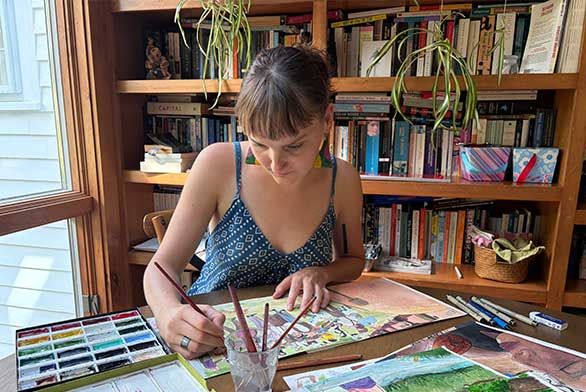
Schwarz is creating this book as a capstone project for a summer internship in July 2026 with the Historic Santa Fe Foundation, a nonprofit dedicated to preserving the city’s buildings and neighborhoods. While not the first Santa Fe Johnnie to intern with the Foundation, she is the first to do so with support from the new James R. Hennessy (SF82) Memorial Endowed Career Pathways Fund. Established by the late alum’s longtime partner, Marc Porter, it honors Hennessy’s ties to his alma mater while celebrating his lifelong passion for architecture and historic preservation.
“I came to Santa Fe for St. John’s but also for the buildings … the way everything emerges from and merges into the landscape,” says Schwarz, who is considering graduate study in architecture or archaeology. Interning with Historic Santa Fe, she felt, would provide an understanding of the legal and administrative processes that help determine which pieces of the past survive. It would also feed Schwarz’s deep curiosity about “questions of historical consciousness … and how people relate to their history and culture through connections to land and water.”
Schwarz had not known until recently that New Mexico’s acequias constitute one of the oldest continuously operating water-sharing systems in the country—or that one such channel, the Acequia Madre, passes within a mile of St. John’s Santa Fe. “This campus is part of a city with so much interesting history, and yet we Johnnies are often unaware of what life was like for the families who were here before we arrived with Aristotle under our arms,” Schwarz observes. Intrigued by these local waterways, Schwarz combed through the Foundation’s considerable archives to learn more.
The governance of these waterways is elegant and ancient, originating with the irrigation practices of the Puebloan peoples and augmented by Spanish settlers. Those who use the water today for their crops, livestock, and gardens have the right to vote for a local mayordomo, who ensures equitable access; they also bear the responsibility of participating in their annual spring cleaning—her book’s titular limpia. Communal disputes arise around fair use of water, but annual limpia feasts—the reward for a long day spent shoveling a year’s worth of accumulated silt, weeds, rocks, and branches from the channels—also promote unity.
“I was thinking of The Scarlet Letter and how cemeteries and prisons were among the first things the Puritans built,” Schwarz notes. “That told you what was central to their world. Here, it is water. That which carries water carries your ability to thrive. It carries all these social, political, and economic bonds.”
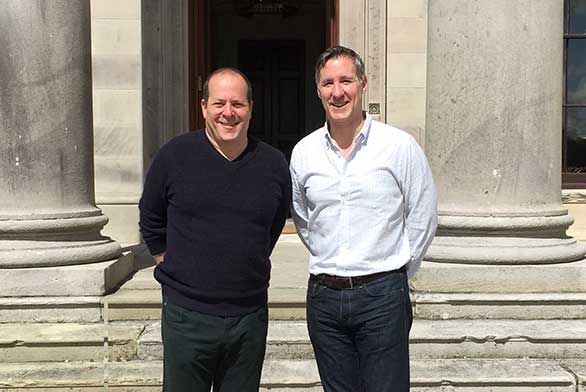
Observations like these would have resonated with Hennessy. “Jim was fascinated by the water distribution system used in Bali,” Porter recalls, “and how the farmers must work together to keep the right amount of water flowing down the hillsides and into the rice paddies.” Hennessy, he adds, who passed away unexpectedly in 2025, “would be so happy” that Schwarz is using her talents to raise awareness of the traditions sustaining a similar system.
Hennessy did not directly pursue a career in architecture or historic preservation, but these interests were woven throughout his academic and professional life. After graduating from St. John’s College, he earned a master’s degree in Anglo-Irish Literature from Trinity College, Dublin; a master’s in historic preservation from Columbia University; and a J.D., also from Columbia. He worked for the Federal Reserve Bank of New York, where he led the Governance and Culture Reform initiative that formed in the wake of the 2008 financial crisis.
“He wrote a lot about how organizations can maintain healthy, ethical cultures. That was what he loved about the Fed: the culture … That, and the building,” Porter says, referring to the Italian Renaissance Revival structure and Lower Manhattan landmark that houses the New York Fed.
“What is amazing to me about Jim is that he looked at buildings and landscapes more seriously than most architects I know, and more seriously than I look at art,” observes Porter, who is the chairman of Christie’s Americas and has worked at the auction house for 35 years. That “rigor of inquiry and exploration” was nurtured by his St. John’s education and by the mentorship of faculty members such as the late tutor and dean Robert Bart.
Bart was one of four Annapolis faculty members who served on the search committee for St. John’s new campus location, which, in 1961, was agreed upon to be Santa Fe. To Hennessy, he bequeathed his library of more than 300 works on architecture.
Bart’s wide-ranging collection mirrored the expansiveness, as well as the inclusivity, of Hennessy’s own interests. “He loved equally the cell of a monk [and] the drawing room of a duke,” Porter says. “He wanted everybody to be able to see both and to see the value in both.” After Hennessy’s passing, Porter gifted the books along with texts from Hennessy’s own collection to St. John’s Santa Fe. He then worked with the college to create an endowed fund that would provide students in either Annapolis or Santa Fe with summer experiences in architecture or historic preservation.
“There are so many formative influences in a person’s life,” Porter says. “For Jim, it was his childhood in Minnesota, and then, as much as St. John’s, it was his time at the Attingham Summer School, studying the great country houses of England, that changed his life.”
Annual funding from the James R. Hennessy (SF82) Memorial Endowed Career Pathways Fund, available in perpetuity, can support a student’s internship or help cover the cost of attending Attingham, a 16-day educational program with a focus on architectural history, art curation, and landscape design. “To give somebody an experience that is truly life-changing—that is the goal,” Porter says. “That should be the goal of everybody.”
Through her summer internship, Schwarz says she arrived at a similar conclusion: “It’s not enough to be aware of history. You have to share those moments of discovering things, because that is how we ensure that what we love is carried forward.”
Like a shoe moving along in the water.