
New Fall Art Exhibitions in Annapolis Pose Questions About Freedom and Trust
Entry is free at the Mitchell Art Museum
Annapolis, MD [September 8, 2026] — /m (The Elizabeth Myers Mitchell Art Museum) at St. John’s College announces its new round of exhibitions for this fall, featuring an Annapolis Liberty Tree-inspired installation conceived for America250, and a separate exhibition of two legendary video artworks. A public reception will be held on Saturday, September 12, from 6:30–7:30 p.m. Both exhibits will be on view from September 13 to December 6, 2026.
Miguel Braceli: Unburial
In the main gallery, artist Miguel Braceli has created a temporary public sculpture and multi-sensory installation that commemorates the 1999 removal of the Annapolis Liberty Tree from the front lawn of St. John’s College’s campus. The massive, 400-year-old tulip poplar was the last surviving Liberty Tree in the U.S.
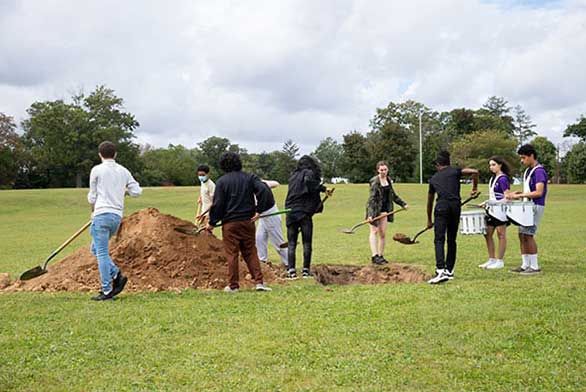
The Annapolis Sons of Liberty—which included four eventual signers of the Declaration of Independence—held hushed meetings at the tree prior to the American Revolution. Criticizing the monarchy was a criminal offense at the time, so these meetings had to be held with the utmost discretion.
“Liberty Trees were powerful symbols,” says /m director Peter Nesbett. “For many, they represented the human will to self-determination. As we think about their rightful place in the American story today, we have to consider what the symbol might mean to us today. This begs asking, ‘Who is free?’ and ‘What do we want to be free for?’”
For this exhibition, Braceli has marked the original site of the Annapolis Liberty Tree with a circle of wildflowers. This temporary, commemorative sculpture will be on view until the flowers wilt and die. Inside the museum, he has transformed the gallery into a secluded twilight garden of flags, symbols, and animated murals; an environment that mourns the loss of the Liberty Tree while opening a conversation about a fabled future shaped by the many ways nature can inhabit freedom. Live flowers emerge from the walls, creating a multi-sensory landscape in which visitors are invited to listen, reflect, and participate in “whisper conversations.”
Through the living metaphor of the tulip polar tree, Braceli translates the logics of nature—growth, interdependence, regeneration, resilience, and transformation—into, rather than in place of, the canonical power-driven visual language of nation-state iconography. The exhibition thus considers the tree not only as a symbol of a lost form of political freedom, but also as an opportunity to imagine how other forms of freedom might take root.
Surveilled or Seen: Sinew of Trust in the Video of Marina Abramović and Lynda Benglis
In the VIDEODROME, /m’s recently launched media space, /m is presenting historic videos by two pioneering artists. Each work explores what it costs us to trust each other — and how important it is that we do.
What is the difference between being looked at versus being witnessed? Between being invasively surveilled versus deeply seen? These questions emerge as we watch the two videos—Abramović’s Rest Energy (1980) and Lynda Benglis’ Monitor (1999)—unfold. We are invited to sit with how much social cynicism deteriorates us, if we allow it to take over and transform our will to trust into one to control. As an antidote to this, each artist seems to posit that we must instead relinquish control if we hope to be loved. Love, then, becomes indistinguishable from the act of choosing not to monitor someone fearfully, but to witness them vulnerably. It is a terrifying and brave, humbling and life-giving choice. We hope watching these works of art help it become easier to make.
Visiting the Museum:
The museum’s fall hours are Thursday, Saturday, and Sunday, from 10 a.m.–6 p.m., and Friday, 2–7:30 p.m. Our exhibitions are always free and wheelchair accessible.
About the Museum:
The only nationally accredited art museum in Anne Arundel County, the Elizabeth Myers Mitchell Art Museum at St. John’s College presents changing art exhibitions to the ever curious. Our mission is to pose persistent and timely questions about the human experience, through art and with extraordinary artists.
About St. John’s College:
In an age of political division and digital distraction, St. John’s College offers the education America needs. Through close reading of 200 great books across 3,000 years—from Plato to Toni Morrison, Augustine to Charles Darwin, Euclid to Albert Einstein—students wrestle with the deepest questions of law, justice, freedom, and human flourishing. At a time when many institutions chase trends, St. John’s returns to first principles. The third-oldest college in America, with campuses in Annapolis, Maryland, and Santa Fe, New Mexico, St. John’s is a refuge for civic renewal, civil discourse, and intellectual courage. Learn more about our undergraduate, graduate, and lifelong learning programs at sjc.edu.
“St. John’s is a high-achieving angel hovering over the landscape of American higher education.” —Los Angeles Times
Contacts:
Sara Luell, Senior Director of Communications and Operations, St. John’s College, 410-295-5557,
Peter Nesbett, Director of the Elizabeth Myers Mitchell Art Museum, 410-626-2536,
Jenny Cawood, Manager (of Artistic Inquiry), Elizabeth Myers Mitchell Art Museum, 410-626-2556,