
From Film Precept to Fulbright: Deana Moss’ (SF24, EC25) Path to Taiwan
May 12, 2026 | By Jeremy Richter (A28)
Deana Moss (SF24, EC25) will spend the 2026-27 school year in Yilan, Taiwan, as a Fulbright English Teaching Assistant (ETA) working with elementary-aged students. Moss completed both her Bachelor of Arts and her Master of Arts in Eastern Classics at St. John’s Santa Fe, and her path to Taiwan can be traced back to an unexpected source of inspiration: a film she watched in a Graduate Institute preceptorial.
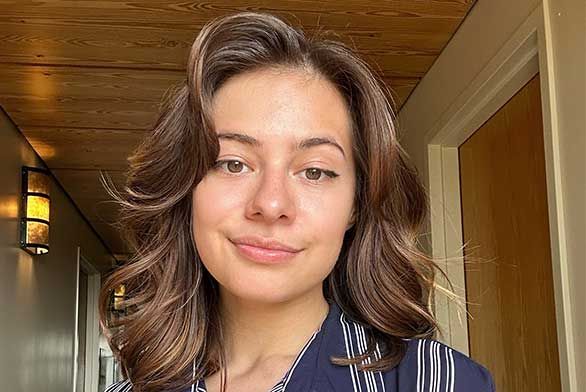
Moss’ desire to learn and to teach began long before she became a Fulbright awardee. She looks fondly upon her time attending public school in Portland, Oregon, but like many Johnnies, she wishes that more time had been set aside to discuss the core texts she and her classmates were reading in English class. While Moss applied to several universities, the personalized admissions process at St. John’s College drew her in. She says, “I got things like socks from different admissions packages, but when I got my Iliad [from St. John’s], I thought, ‘Wait, this is amazing. This is what I want from a college.’”
At St. John’s, Moss spent three years as a lab assistant, helping to lead discussions while preparing classroom practica. Being a lab assistant, she says, forced her to “be organized, take time to really understand things, and be more careful with what I was reading.” She also led her intramural team, the Olympians, as a captain, and served as an academic assistant for Summer Academy following graduation.
Moss is especially thankful for her experience at Summer Academy, which occurred as she was considering different career paths. “Summer Academy was really a good opportunity to see how I felt having a bit more of a teaching job,” she says. “It helped me ask questions like, ‘Is this something that I want to pursue?’ ‘Do I like tutoring?’ and ‘Can I explain things to people who are confused?’”
Moss later found work in the Santa Fe area as a Spanish teacher at a local Montessori school. Then, one of her friends jokingly suggested that she join the Graduate Institute as a way to keep her on-campus housing. Moss took the suggestion seriously. “I remembered how I felt as a high schooler when I discovered St. John’s in the first place,” she says. “I thought, ‘Yeah, I can do that. I have no idea what I’m throwing myself into, but it seems cool.’ I was taking a leap of faith.”
In the Eastern Classics program, Moss took a film preceptorial taught by Santa Fe Associate Dean for Graduate Programs David Carl, which screened movies from countries including China, Japan, and Taiwan. In the preceptorial, Moss remembers watching the Taiwanese film Yi Yi (2000), which follows three generations of a middle-class family living in Taipei throughout the course of a single year. The production won Best Director at the Cannes Film Festival and was acclaimed by many critics as the “best film of the year.”
Yi Yi sparked in Moss a desire to experience the film’s setting for herself: “It raised the question for me of what it would look like in person,” she recalls, “which made me think, ‘Oh, maybe I want to go to Taiwan.’” This led Moss to select the East Asian nation as her destination while applying to the Fulbright Program as an ETA.
Moss began the application process during her spring semester, which required a resume, several references, and multiple short essays. Working closely with the Santa Fe Office of Personal and Professional Development’s (OPPD) Charlie Bergman, she remembers going through “about nine or ten drafts for each of the personal questions” on the application. “Every word counts for those essays,” she says.
For others who are interested in applying to the Fulbright Program, Moss has the following advice: “It’s really a matter of getting to know yourself. For example, something I had been doing prior to applying or even thinking about Fulbright was journaling. I would write down my thoughts, and that ended up coming in handy when it came to answering the essay questions. I knew what I wanted to say, and more importantly, I had developed a voice, which is important to have in your writing to make yourself stand out.”
Moss’ application drew on her experience as a Spanish teacher in Santa Fe, where she designed her own curriculum for students ages 2-12. Her teaching emphasized the close relationship between language and culture, showing students how everyday Spanish words reflect the influence of Hispanic culture in the Southwestern United States. In her essays, she outlined plans for a similar approach in Taiwan, where she hopes to use American geography, history, and language to teach Taiwanese students English while fostering a new understanding of how cultures are shaped. After completing her year as a Fulbright ETA, Moss says she looks forward to sharing Taiwanese traditions with her American students and facilitating cultural exchange.
Moss advises Santa Fe Johnnies interested in pursuing a Fulbright award to consult the OPPD. She calls Bergman the “magical touch” who “helped me create the version of myself that was applying for Fulbright.” She says that applying to Fulbright requires thinking differently than many Johnnies are used to, emphasizing the competitive nature of the process. She remembers asking, “How do I portray myself in a way that tells Fulbright that I’m a serious applicant and that I want to do this?”
After completing the Fulbright ETA program, Moss hopes to bring her experience into classrooms across America. She says, “My interest is teaching kids English and how to retain it, either as a teacher or in some type of leadership position. I want to help ensure that taking a foreign language actually means something. I also wonder what the best ways are to teach a foreign language, and how we can make the experience better for students.”
When asked what a St. John’s education had given her, Moss jokingly answered, “Headaches over the most ridiculous questions,” then added, “More than anything, [a St. John’s education] helped me think about my relationship to life and the world around me in a more serious way, which led to me wanting to do [the] Fulbright. It made me ask, ‘How do I make a difference?’”