
Take a Tour of St. John’s College in Annapolis—Steeped in United States and Maryland History

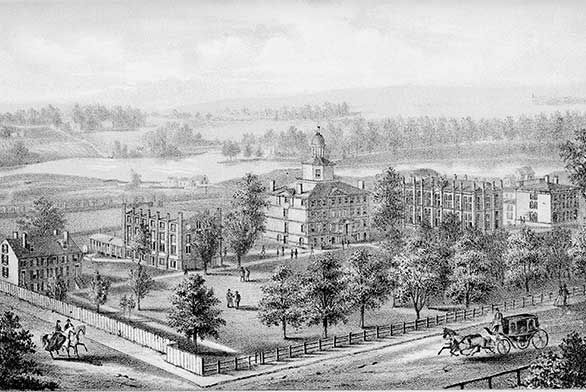
Welcome to St. John’s College, the third oldest college in America, founded in 1696 as the King William’s School. Four of the college’s founders signed the Declaration of Independence in 1776, George Washington visited the school in 1791, and Abraham Lincoln walked the grounds in 1865. Other notable visitors include First Lady Eleanor Roosevelt, civil rights leader W. E. B. Du Bois, and American folk legend Woody Guthrie.

Today, the college is one of the country’s premier liberal arts colleges due to our distinctive Great Books curriculum. At St. John’s, undergraduate and graduate students read more than 200 of the greatest books ever written across dozens of subjects and discuss those books with our faculty in small, seminar-style classes.

The campus grounds are open to the public. The Admissions Office, located in the Charles Carroll Barrister House, offers student-led campus tours. Or, follow along with the self-guided tour below to learn more about the college’s historical sites of interest.

Sites of Interest

Alumni Memorial Tablets

Alumni Memorial Monument Annapolis Campus

These memorials, located on front campus, honor the St. John’s alumni who died in service to their country.

History of the Tablets

St. John’s College is today known more for books than brawn, but the first Army ROTC unit in the U.S. was formed at St. John’s College in 1917—and during the ensuing Great War, West Point was the only other institute of higher education with more alumni serving in the conflict as officers.

In 1920, a monument dedicated to Johnnie soldiers of World War I was erected on St. John’s College’s front campus, funded by alumni: 452 St. John’s alumni and students had enlisted in the United States Military during the war, and 24 lost their lives. Famed German American sculptor Hans Schuler, one of Baltimore’s most popular artists at the time, created a stele, or vertical slab with surface ornamentation, in bronze, adorned with a relief of Alma Mater holding a drawn sword, mourning over a shield inscribed with the names of the St. John’s alumni who served.

Forged in the Baltimore workshop of renowned bronze caster James Arthur Limerick and unveiled in 1920 by then-Assistant Secretary of the Navy Franklin Delano Roosevelt, the monument reads, “Erected by the alumni of St. John’s College to their fellow alumni who in the world war gave their all. Four hundred and fifty-two of our men answered their country’s call. There is no record that one failed in his duty.”

Dedicated in 1991 by the St. John’s College Alumni Association, a second, later tablet laid at the site memorializes all those associated with the college lost in military conflicts.

Barr-Buchanan Center

Graduate Institute Barr-Buchanan Center in Annapolis Campus

Named for the founders of the college’s academic program, the BBC serves as the home of the St. John’s College Graduate Institute, a distinctive community of learning.

History of the BBC

New Program meets old at the Barr-Buchanan Center: Constructed in 1899, the Annapolis Graduate Institute’s homebase—named for educational reformers Stringfellow Barr and Scott Buchanan—was formerly known as Woodward Hall after the father of banker, philanthropist, and Board of Visitors and Governors member James T. Woodward. Famed Gilded Age architect T. Henry Randall, the figure behind noted local buildings such as Baltimore’s Lyric Opera House, designed the Beaux-Arts-style building, which served throughout the years as an armory, science building, and campus library. A 1932 renovation transformed the entire building into the school’s library, which remained there until 1996, when its contents were moved across campus, hand by hand, to the newly christened Greenfield Library.

Bookstore

Annapolis Campus Bookstore

Stop by the campus bookstore to pick up a copy of any book on the curriculum, or get some St. John’s swag such as T-shirts, baseball caps and more. The bookstore is open to the public, generally Monday through Friday.

Chancellor Johnson House

Chancellor Johnson House in Annapolis Campus

One of two historic Annapolis homes moved to St. John’s College grounds and the oldest building on campus, the Chancellor Johnson House was given a new lease on life in 1937. Chancellor Johnson now houses faculty offices, and is not open to the public.

History of the Chancellor Johnson House

Built around 1720 on 9 Northwest Street, the Chancellor Johnson House is one of Annapolis’s earliest surviving gambrel-roof colonial dwellings, and the oldest building now located on the campus. By 1778, the property had come into the possession of Allen Quynn, a cordwainer and former mayor of Annapolis, who lived there until his death in 1821.

Ten years later, in 1831, the modest wood-frame house, along with several other brick and frame buildings on the lot, was purchased by John Johnson, Jr., an 1821 St. John’s College graduate who later served as Chancellor of Maryland from 1846 until the position was abolished in 1851. The Johnson family retained ownership until 1918. Because both John Johnson and his brother, Reverdy Johnson (St. John’s Class of 1811), were associated with the house, it has often been mistakenly referred to as “Reverdy Johnson House.”

After changing hands several times, the historic house was acquired by the Chesapeake and Potomac Telephone Company, which planned to demolish it. In 1937, St. John’s College, in collaboration with early local preservationists, arranged for it to be moved to the southwestern edge of campus, adjacent to Mellon Hall’s eventual location. It was one of two historic Annapolis homes relocated to St. John’s, the other being the Charles Carroll the Barrister House (moved in 1955).

Architecturally, the house remains a classic early-eighteenth-century structure: a one-and-a-half-story, five-bay dwelling measuring about 14 by 40 feet, with beaded weatherboard siding, a steep gambrel roof, three asymmetrical dormers, and a distinctive off-center T-shaped chimney rebuilt after the move. Its interior preserves a simple plan of three rooms on each floor.

Charles Carroll the Barrister House

Charles Carroll the Barrister House in Annapolis Campus

Home to the St. John’s College Admissions Office, the Charles Carroll the Barrister House is one of Annapolis’ oldest surviving townhouses. Stop by to learn more about the college or to schedule a tour.

History of the Charles Carroll the Barrister House

One of Annapolis’ larger and oldest surviving townhouses, and a rare example of early eighteenth-century architecture, the Charles Carroll the Barrister House faced the wrecking ball before being rescued by preservationists in the mid-1950s.

Constructed in 1732, the house originally stood at the corner of Main Street and Conduit Street (today 177 Main Street). It was the birthplace of Charles Carroll the Barrister, who was a noted colonial lawyer, political leader, and a principal author of the Declaration of Delegates of Maryland. His father, Dr. Charles Carroll, was a prominent surgeon and one of colonial Maryland’s most affluent citizens.

By the mid-twentieth century, the house was known as the “Tydings’ House” after its last private owner, Eleanor Davies Tydings-Ditzen, who played a key role in facilitating its preservation: when the property was sold at public auction and targeted for redevelopment, Tydings-Ditzen donated the building to Historic Annapolis.

Working with St. John’s College, preservationists raised the funds necessary to relocate it: the entire structure was cut into sections, lifted onto a flatbed truck, and moved across town to campus. Architect James W. Burch oversaw its restoration, preserving features such as the brick end walls laid in all-header bond, the slate-clad cross-gable roof, and the gable dormers. Today, the Charles Carroll the Barrister House is home to the St. John’s College Admissions Office.

Chase-Stone House

Chase-Stone House in Annapolis Campus

Before being converted to student housing, Chase-Stone House provided faculty housing and later served as a fraternity house. Chase-Stone is not open to the public.

History of the Chase-Stone House

Named for Maryland Declaration of Independence signers and St. John’s College board members Samuel Chase and Thomas Stone in 1939—the same year the building was converted into a men’s dormitory—Chase-Stone was initially built in 1853 as a duplex for the school’s president and vice-president. Designed by leading period architect Nathan Starkweather, it formed part of the original “Yale Row” series of buildings at St. John’s, along with Paca-Carroll, Humphreys, McDowell, and Pinkney halls. Following a short-lived stint as a fraternity house from 1929-1937, Chase-Stone was transformed into a residence hall, and remains so to this day following a substantial renovation in 1963.

College Cannon

Chase-Stone House in Annapolis Campus

This cannon, one of 13 dredged out of the Baltimore harbor, was used during the War of 1812.

History of the College Cannon

Among 13 dredged from Baltimore Harbor, this cannon was used in the defense of Fort McHenry in the War of 1812. It was erected on college grounds in 1914 by the local Annapolis chapter of the Daughters of the American Revolution. Its presence evokes the legacy of St. John’s College alumni Francis Scott Key (Class of 1796), whose famous poem, “The Defence of Fort M’Henry,” was eventually adapted as lyrics to The Star-Spangled Banner.

French Monument

French Monument in Annapolis Campus

This monument, dedicated in 1911 by President William Howard Taft, honors the French soldiers and sailors who were buried on the shores of College Creek during the Revolutionary War.

History of the French Monument

This 1911 monument honors the French combatants who were buried on the shores of College Creek during the Revolutionary War. It is the first documented monument to Unknown Soldiers anywhere in the world.

In September 1781, French soldiers under the command of the Marquis de Lafayette reached Annapolis after marching south from Rhode Island toward Virginia. Encamped on the banks of College Creek on what is today St. John’s back campus, they would later prove to be an invaluable asset in the United States’ victory against England in the Siege of Yorktown.

Sadly, several dozen of the French soldiers never lived to see that battle and died of disease. They were buried on a bluff overlooking College Creek, their gravesites visible until the Union army commandeered St. John’s campus for use as a Union Hospital and parole camp in the 1860s.

Today, this stele overlooking College Creek pays homage to our fallen American allies. It exists thanks to a French U.S. Naval Academy professor named Henri Marion: In 1905, Marion had returned to his motherland while assisting with the historic repatriation of Revolutionary War naval hero John Paul Jones to the U.S. Naval Academy. During this trip, Marion had observed his fellow countrymen tending to a cemetery for Confederate sailors from the CSS Alabama, which had sunk off the port city of Cherbourg in 1864. Inspired by this honorable act and familiar with the French soldiers’ unmarked graves back in Annapolis, Marion returned to the U.S. and lobbied for their formal recognition.

Marion found a supporter in Maryland Secretary of State Colonel Oswald Tilghman, a member of the Sons of the American Revolution fraternal and civic group. Tilghman had previously wanted to plant a memorial grove at the gravesite. Instead, with funds raised by the Sons, they erected a stone and bronze relief by world-renowned sculptor J. Maxwell Miller. It depicts the figure of Memory holding a shield and an olive branch. Two stones at her feet read, “Ci git un marin de la France” and “Ci git un soldat de la France”—“Here lies a French sailor,” and “Here lies a French Soldier.”

Unveiled to the public in a much-publicized ceremony conducted by President William Howard Taft and French ambassador to the United States Jules Jusserand, the 1911 dedication was attended by descendants of the Admiral François Joseph Paul de Grasse, who had helped George Washington achieve victory in the Battle of Yorktown, and the Marquis de Lafayette.

Greenfield Library

Greenfield Library in Annapolis Campus

The Greenfield Library is housed in the renovated building once known as the Maryland Hall of Records. The library’s collection consists of over 102,000 books, recordings, videos, and print and electronic periodicals. The library is open to the public.

History of the Greenfield Library

Designed by architect Lawrence Hall Fowler, the Greenfield Library was opened in 1935 as the Maryland Hall of Records, which housed the State Archives. Upon its completion, the state building made headlines and was featured in Architectural Record.

The State Archives eventually relocated, and the Hall of Records building was renovated by architect Travis Price (SF71), a Johnnie alum, into the Greenfield Library. Price preserved the original entryway, registration room, and reading room, but the remaining interior was transformed into a modern, light-filled cathedral of learning. As for its many books, they were transferred hand-by-hand, title by title, across the campus front lawn from the Barr-Buchanan Center (formerly Woodward Hall) by members of the college community using canvas totes.

The St. John’s College Library has existed in several iterations throughout the college’s existence: Perched high above campus in the McDowell Hall cupola from 1794-1835, the library was relocated to Humphreys Hall until 1899, and then to Woodward Hall (today known as the Barr-Buchanan Center). It experienced a brief stint in Mellon Hall from 1967-1969 as Woodward Hall underwent renovations and ultimately wound up in the renovated former Maryland Hall of Records in 1996 when it was newly rechristened as the Greenfield Library.

Humphreys Hall

Humphreys Hall in Annapolis Campus

Once used as a Civil War hospital, Humphreys is now home to the college’s mailroom on the lower level. The upper levels serve as student residences and are not open to the public.

History of Humphreys Hall

Erected in 1837, Humphreys Hall, the first building to be officially commissioned by St. John’s College, is named for Reverend Dr. Hector Humphreys, the college’s fifth president. It formed part of the original “Yale Row” series of buildings at St. John’s, along with Paca-Carroll, McDowell, Chase-Stone, and Pinkney halls. It served as a dormitory until the Civil War, when the Union Army took over the campus and repurposed Humphreys Hall as a hospital and morgue for the wounded and dead. It later served as home for administrative offices until being renovated and converted back into a residence hall in the late 1950s. The campus bookstore was located in the Humphreys Hall basement until mid-2024, when it relocated to Edensword Hall. The space is now home to the campus mailroom and a lounge area.

Iglehart Hall

Iglehart Hall in Annapolis Campus

Dating back to 1909, fitness center/gymnasium Iglehart Hall (nicknamed “Temple Iglehart”) is home to one of the oldest suspended running tracks in the United States.

History of Iglehart Hall

Dating back to 1909, the fitness center/gymnasium Iglehart Hall (nicknamed “Temple Iglehart”) is named in honor of Edmund Berkeley Iglehart (Class of 1894), a U.S. Army second lieutenant who was named the school’s Commander of Cadets and Professor of Military Science in 1907. A lifelong sports enthusiast, Iglehart played both football and baseball in his undergraduate years and served as a football coach for the school while on leave from the army. He assumed the position of head football coach upon his return to St. John’s, and he tirelessly advocated for the college to erect a designated gymnasium.

Iglehart’s persistence paid off, but poor health meant he was unable to fully enjoy the fruit of his labor: He resigned from St. John’s due to illness in 1909, right around the gymnasium’s completion and a year before its formal dedication ceremony. He died in 1920, prompting the college to name the building in his honor.

Temple Iglehart is today home to a weight room, a basketball court, multi-purpose room/yoga studio, and one of the oldest suspended running tracks in the U.S. Long ago, it also included a rifle range and a swimming pool.

Plaques lining its interior walls of Temple Iglehart commemorate Johnnies from the nineteenth and twentieth centuries, each one inscribed with a class motto in Latin. Some of our favorites are Nulla dies sine linea (“no day without a line”) and Esse quam videri (“to be, rather than to seem”). These mottos come from Roman writers Pliny the Elder and Cicero, and they serve as a challenge to every Johnnie who enters the gymnasium.

Liberty Bell

Liberty Bell in Annapolis Campus

The replica of the Liberty Bell standing on the front campus was cast in 1950 by the U.S. Department of Treasury. This is the state of Maryland’s only copy of the Liberty Bell.

History of the Liberty Bell

Following World War II, the United States Treasury launched a fundraiser as part of the Marshall Plan through a “Save For Your Independence” savings bond drive. To market the drive, the Treasury commissioned a replica of the Liberty Bell for each U.S. state and territory.

Most of these bells today reside in their respective U.S. state capitol buildings. The Annapolis Chamber of Commerce, however, secured the large percussive instrument as a landmark for St. John’s front campus after it returned from a statewide publicity tour promoting bond sales. It’s remained there since 1951, elevated by a pedestal that was paid for with pennies donated by Anne Arundel County schoolchildren. Its plaque reads:

This reproduction of the Liberty Bell was presented to Maryland by direction of The Honorable John Snyder, Secretary of the Treasury as the inspirational symbol of the United States savings bonds independence drive from May 15 to July 4, 1950. It was displayed in every part of the state.

The dimensions and tone are identical with those of the original Liberty Bell when it rang out our independence in 1776.

Liberty Tree

Liberty Tree on Annapolis Campus

This tulip poplar tree is a surviving scion of the last surviving and the oldest of the country's Liberty Trees—historic natural landmarks that, long ago, served as meeting spots for American patriots.

History of the Liberty Tree

This tulip poplar tree in front of the Greenfield Library is a scion of the last surviving and the oldest of the country’s Liberty Trees—natural landmarks that served as meeting spots for American patriots throughout the original Thirteen Colonies. It was planted in 1889 to commemorate the 100th anniversary of St. John’s College’s founding.

Its mother, the original St. John’s Liberty Tree, was much older—according to one scientist’s estimate, more than 400 years old. Long ago, it grew near the Barr-Buchanan Center (formerly Woodward Hall), on a stretch of land that served as the de-facto town common for Annapolitans. William Eddis, a loyal agent of the British crown who held the position of “Surveyor and Searcher” in the Annapolis Customs Office from 1768-1777, observed the tree’s role as a hub for Patriot politicos in a letter written on Wednesday, September 27, 1775. (Notably, said archival document is also the only contemporary documented reference to dub the tree a “Liberty Tree.”) Pre-Revolution, it’s said to have been where the Articles of Peace and Friendship land transfer agreement between early Maryland colonist and the Susquehannock occurred in 1652. Post-Revolution, it was the site of a special meeting on July 4, 1812, where locals convened to “express their devotion to the sacred cause of their country.”

The original historic tree—which, for many decades, towered over the campus green as the nation’s last Colonial-era Liberty Tree—was stabilized with concrete filling in 1907 at the direction of arborist John Withers, only to fall victim to Hurricane Floyd 90 years later. But its scion lives on—and a plaque on its trunk, affixed by the Peggy Stewart Chapter of the Daughters of the American Revolution on October 19, 1936, pays tribute to the tree’s illustrious mother. In 2007, the St. John’s College Alumni Association planted an unrelated tulip poplar at the site of the original Liberty Tree on front campus.

Want to grow your own Liberty Tree in your backyard? Retired Alleghany County forester Francis “Champ” Zumbrun has gathered and propagated the daughter tree’s seedlings (all genetically identical to the original tree) since 2000.

McDowell Hall

McDowell Hall in Annapolis Campus

The former governor’s mansion, McDowell Hall, was completed in 1789 and serves as the foundation for the college; it is now one of the oldest academic buildings in continuous use in the country. In addition to classroom space, the Great Hall serves as a meeting place for the community.

History of McDowell Hall

Long known simply as the College Building, McDowell Hall is the third-oldest building on campus, the oldest still in its original location, and one of the nation’s oldest academic buildings in continuous use. Its story began in 1742, when builders began erecting a residence for Colonial Governor Thomas Bladen. Construction efforts ceased only two floors in after the Assembly refused to grant additional money for its construction, and the partially finished structure stood abandoned for decades, earning it the nickname “Bladen’s Folly.”

The State of Maryland granted the mansion to St. John’s upon its charter in 1784, and it was formally named in honor of the college’s first president, John McDowell. Architect Joseph Clark, who also worked on the Maryland State House, added a third floor, cupola, and bell tower, the last of which functioned as the school’s very first library.

St. John’s began holding classes in McDowell Hall in 1789, and for many years, it served as a home for the entire college. Francis Scott Key lived in McDowell Hall and attended classes there. Notable visitors walked its halls, including George Washington, and President Calvin Coolidge observed a parade from McDowell Hall’s front porch when he visited Annapolis to celebrate Colonial Day on May 15, 1928.

For centuries, McDowell remained the enduring heart of St. John’s—even in 1909, when a fire gutted its interior, prompting alumni to raise funds for its restoration. In addition to classroom space, it regularly serves as the location for concerts, lectures, and waltz parties on campus.

Mellon Hall

Mellon Hall on Annapolis Campus

One of just a handful of famed architect Richard Neutra-designed buildings in existence on the East coast, Mellon Hall features classrooms, meeting spaces, a black box studio theater, and the Francis Scott Key Auditorium, named for the famous St. John’s alum who penned “The Star-Spangled Banner.” President Dwight Eisenhower, after landing in a helicopter on back campus, took part in the dedication of Mellon Hall and the auditorium in 1958. Be sure to stop by for a free Friday night lecture, concert, or theatrical production.

History of Mellon Hall

Designed by Richard Neutra, Mellon Hall is one of the famed modernist architect’s only remaining works on the East Coast.

Neutra is remembered for his open-plan architectural projects, which incorporated steel and glass in spaces that blurred the lines between indoors and outdoors. Such is exemplified in his best-known work, the Kaufmann Desert House in Palm Springs, California, and such is also seen in Mellon Hall, which was completed in 1958 to accommodate the college’s growing number of students following World War II.

Initially dubbed the “Art and Science Building,” Mellon Hall is named for philanthropist Paul Mellon, who provided financial support for the building. (Mellon briefly enrolled in the New Program in 1940 but left to join the Army on the cusp of World War II.) It is designed to integrate with the college’s traditional Georgian architecture, emphasizing a horizontal, sprawling model that would not clash with the historical, brick buildings of the campus.

Mellon was initially U-shaped and opened to form an agora, reminiscent of ancient Greek poli. Swathes of planted greenery inside the lobby provide a sense of the outdoors, and the glass-faced “Fishbowl” lounge across the hall features one of Neutra’s hallmarks: the so-called “spider’s leg,” which extends the room’s steel ceiling beams outdoors. Another unique original architectural feature is its metal “fins” on the building’s southwest and northwest windows, which can be rotated with the push of a switch to adjust shade levels throughout the day.

Mellon Hall has undergone two renovations. The first, conducted by Bohl Architects in 1988, closed off the then-open courtyard and expanded the building to include executive offices and the Mitchell Art Museum. In recent years, the Ziger/Snead architecture firm restored the historic lobby and the building’s custom-designed Conversation Room across the hall, which hosts question periods after formal lectures. Today, Mellon Hall is home to soundproofed music rooms, custom-designed science labs, a dark room, and the college’s beloved “pendulum pit,” a working replica of French physicist Jean Foucault’s swinging suspended orb that provides a non-astronomical demonstration of the earth’s rotation.

/m - The Mitchell Art Museum

Mitchell Art Museum on Annapolis Campus

Located in the center of the campus, the Elizabeth Myers Mitchell Art Museum is the only nationally accredited art museum in the county. /m presents changing art exhibitions to the ever-curious. Its mission is to pose persistent and timely questions about the human experience through art and with extraordinary artists. The museum is free and open to the public. Visit sjc.edu/mitchell for current exhibit information and operating hours.

New Program Seal

Program Seal on the Annapolis Campus

The bronze-cast New Program seal is located at the foot of the quad and features the motto “Facio liberos ex liberis libris libraque,” which translates to “I make free adults from children by means of books and a balance.” The “New Program” is the name for the Great Books curriculum that the college adopted in 1937. 

Paca-Carroll House

Paca-Carroll House on the Annapolis Campus

Completed in 1857 and later named for two Maryland Declaration of Independence signers, Paca-Carroll House served as faculty housing before its conversion to a student residence hall. It is not open to the public.

History of Paca-Carroll House

Completed in 1857, Paca-Carroll House received its current name in 1939 in honor of Maryland Declaration of Independence signers William Paca and Charles Carroll of Carrollton. Paca, the third governor of Maryland, gave money to the college and signed the St. John’s Charter in 1784, and Carroll was also a donor as well as a member of the Board of Rectors, Visitors and Governors.

Paca-Carroll House was initially built as a Federal-style duplex that housed early faculty members such as professor Abram Claude, an alum, board member, and four-term mayor of Annapolis, and Reverend J.M. Dashiell, a prominent Episcopal minister and reformer who taught Greek and Latin. In subsequent years, it would go down in history as the birthplace of famed author and screenwriter James M. Cain (Double Indemnity, The Postman Always Rings Twice, Mildred Pierce), thanks to his father James. W. Cain, a faculty member and administrator who was later named president of Washington College. Paca-Carroll was later turned into student housing. It formed part of the original “Yale Row” series of buildings at St. John’s, along with Humphreys, McDowell, Chase-Stone, and Pinkney halls.

Pinkney Hall

Pinkney Hall on Annapolis Campus

Built in 1858 and named after William Pinkney, the 17th U.S. Attorney General, Pinkney Hall is the third-oldest residence hall on campus. Its ground level is home to the St. John’s College Public Safety Office; the remainder of the building is student housing and is not open to the public.

History of Pinkney Hall

Built in 1858 and named after William Pinkney, the 17th U.S. Attorney General, and a firm defender of the state funding for St. John’s in 1805, Pinkney Hall is the third-oldest residence hall on campus. It was designed in the Gothic Revival style by architect Nathan G. Starkweather and built by local craftsmen Daniel M. Sprogle and Daniel H. Caulk. Its tall brick buttresses, arched windows, and low-pitched roof with gabled parapets give it the vertical solemnity of a small fortress that echoes the nearby Humphreys Hall, which was built by the same team.

Alongside Paca-Caroll, Humphreys and Chase-Stone, Pinkney completed the “Yale Row” vision, four halls standing in opposite flanks as if to guard McDowell, the college’s heart. It has been renovated multiple times, most recently in 1998, a project that earned the 1999 Excellence in Construction Award for its careful preservation of original materials and addition of accessibility features. Pinkney’s ground level is home to the St. John’s College Public Safety Office. The remainder of the building is student housing and is not open to the public.

Ptolemy Stone

Ptolemy Stone on Annapolis Campus

A Ptolemy Stone is an ancient device for measuring the angle of the sun compared to the earth, which is the basis for many navigational devices such as the sextant. This Ptolemy Stone is one of the only working versions in the country. Johnnies take four years of math and science, and all first-year students use the device when studying astronomy.

History of the Ptolemy Stone

Originally installed on the quad, the Ptolemy Stone now sits outside Mellon Hall. This quadrant-and-ring astronomical instrument, described by Ptolemy in the Almagest, is used to measure and record the altitude of the sun at noon, while the ring matches the plane of the equator and is used to mark the equinox. Measurement of the angular difference between the sun and the equator is the basis for many navigational devices, such as the sextant.

The Ptolemy stone in Annapolis is one of only two working versions in the country; the other is, perhaps not surprisingly, at St. John’s College Santa Fe.


Learn More About St. John’s College History