

Ancient Greek Ghosts of the St. John's Program, Ranked
Oct. 7, 2026 | By Ashton Babiarz (A29)
Ancient Greek is the backbone of the St. John’s College Program. Freshmen kick off their first seminar with Homer’s Iliad, and seniors culminate their time on campus by reading Plato’s Phaedrus. With a variety of plays, poems, treatises, and dialogues, it’s no surprise that there’s something for everyone—especially someone ready to get in the Halloween mood.
Many of the ancient Greek works we read (and, full disclosure, at least one Roman one) feature all manner of ghosts; throughout the course of their study, Johnnies are introduced to a variety of these characters. Whether you’ve finished or are just beginning the Program, it’s worth your while this haunting season to revisit some of the most memorable spirits of antiquity, from tragic shades to supernatural guides—and, at the end, even terrors straight from the underworld.
SADDEST GHOST: CREUSA (THE AENEID)
Although written by a Roman poet, the Aeneid stems from Greek myth. Its hero, Aeneas, embarks on a great journey fleeing the fall of Troy, eventually going on to found his own city. While Troy burns, Aeneas and his family manage to flee the slaughter, only to realize too late that amid the panic, his beloved wife has been left behind. Though exhausted and terrified, he returns to Troy, risking his own life to desperately call out his wife Creusa’s name. In a blink, her apparition appears amid the flames of their home.
Aeneas’s voice, per Robert Fagles’s 2006 translation, is described as “choked in [his] throat,” while she gently says farewell, telling him to find a new home and a new wife, but to always love the son they share. Then she dissolves, and all that’s left of her is the wind. In tears, Aeneas reaches out to embrace her three times, and three times she slips like mist through his hands. This scene is devastating! As he dives back into a war zone for a love already lost, Aeneas’s raw grief pours from the page. Then, before he can touch her or even say a final word, his wife vanishes from his grasp forever.
RUNNERS-UP, SADDEST GHOST: PATROCLUS (THE ILIAD) AND ANTICLEIA (THE ODYSSEY)
Although none of these other spirits can match the anguish of Creusa, there are plenty of other ghosts whose appearances invoke despair. The story of the soldier Patroclus in the Iliad is not dissimilar to Creusa’s. After he dies in battle, he appears in the dreams of his closest comrade, Achilles, urging him to rouse from his debilitating grief and self-blame to begin a proper burial. In Fagles’s 1990 translation, he entreats Achilles, “Never bury my bones apart from yours, Achilles, let them lie together ... just as we grew up together.” Neither can bear to be separated from their lifelong friend. At the sight of him, Achilles cries and attempts to throw his arms around him; like Creusa, the ghost only slips away.
Conversely, when Odysseus visits the underworld during his travels in Homer’s Odyssey, it is his choice to seek out the dead. All the same, he’s heartbroken to see the ghost of his mother, Anticleia. She shares that her death was caused by her longing for him while he was away waging war. Like Aeneas, three times Odysseus rushes to hug her, and three times her spirit dissipates like a dream.
MOST HELPFUL GHOST: TIRESIAS (THE ODYSSEY)
In the Odyssey, the titular Greek king struggles for 10 long years to return to his home of Ithaca after the Trojan War, only to be intercepted by monsters and disasters at every turn. It’s late in his journey when he ventures to the realm of the dead, seeking the advice of the famed seer Tiresias. A swarm of spirits greets him at the gate. Of all who meet him, though, only one can help Odysseus on his way home.
Tiresias warns that his misfortunes are not over, for he has angered the god Poseidon. Then the seer goes on to describe the single path that may be taken to avoid the god’s wrath: a series of challenges, testing his abilities and his command of his crew. Although Odysseus fails some of these tests and is thus delayed on his journey home, he knows what to expect—and how to appease the vengeful Poseidon, allowing his remaining days to be lived in peace. If not for Tiresias, Odysseus likely never would have made it home at all.
RUNNER-UP, MOST HELPFUL GHOST: HECTOR (THE AENEID)
In comparison to Tiresias guiding Odysseus step by step to a safe homecoming, Hector gives Aeneas far less assistance. However, the night he loses his wife, Aeneas is a hair away from losing everything. In Book 2 of the Aeneid, he’s asleep while the Greeks first infiltrate Troy. The specter of Hector visits in a dream (frightening poor Aeneas, as the ghost looks like he did after death, a mutilated corpse dragged through the dust) and wakes him in time to escape the wreckage. Though the survivors of Troy still have a harrowing journey ahead, it’s thanks to Hector that Aeneas escapes not only with his own life but with his father and son.
MOST RESENTFUL GHOST: AGAMEMNON (THE ODYSSEY)
It’s a common trope to see ghosts portrayed as bitter, lingering over their unsatisfying lives and unjust deaths, in ancient Greek works just as much as modern ones. One example is a briefly featured character in the Odyssey, a man named Elpenor who’s angry over his foregone burial. Some, though, have more reason to keep stewing in the afterlife.
When Odysseus is met with hordes of shades at the gates of Hades, not all are there to guide him. As soon as he lays eyes on his friend Agamemnon, a great king in life, Odysseus calls out to know what became of him after they parted ways. Agamemnon recounts how his wife, with another man, conspired to murder him.
Agamemnon’s anger is understandable! There’s a definite hatred to how he speaks of this betrayal: in Robert Fitzgerald’s 1961 translation, the king describes his death as “miserable,” his wife as “heartless,” “bestial,” and a “traitress.” Even further, he says she “defiled herself and all her sex”—and goes so very far as to tell Odysseus to hide from his own wife when he returns, in case she is unfaithful! Now his grudge seems a bit extreme. He may be dead and gone, but Agamemnon clearly isn’t moving on anytime soon.
RUNNER-UP, MOST RESENTFUL GHOST: ACHILLES (THE ODYSSEY)
Right after his wretched conversation with Agamemnon, another deceased friend appears to Odysseus—Achilles—and he’s grateful to see the warrior again after being present for his death in battle. And once more, he’s greeted with wholly founded bitterness.
Achilles asks what Odysseus is doing visiting them, referring to himself and the other dead as “dimwitted” and “the after images of used-up men.” Odysseus is shocked to hear a great hero speaking like this. He attempts comfort, but Achilles is quick to retort, saying he’d prefer a humble life over a glorious death any day. It’s a lesson learned too late, and one he’ll be mulling over all the rest of eternity.
FUNNIEST GHOSTS: EURIPIDES AND AESCHYLUS (FROGS)
Aristophanes’ Frogs is currently only taught in the Graduate Institute literature segment or read in undergraduate preceptorials, but its ghosts are simply too good not to mention. Frogs is a comic play in which Dionysus, searching for better entertainment, descends to the underworld to bring up the ghost of the Athenian playwright Euripides. The journey is ridiculous the whole way down.
When Dionysus reaches the palace, he stumbles into judging a competition between Euripides and fellow playwright Aeschylus to be crowned the master of tragedy. It ends up being like an ancient Greek rap battle—the two writers sling critiques and insults back and forth, each parodying the style of their own poetry. Euripides is crass; Aeschylus is lofty and flowery. The hilarity builds with every line, so go and enjoy it for yourself. I won’t spoil the winner!
SCARIEST GHOST: CLYTEMNESTRA (THE EUMENIDES)
...And it’s not close.
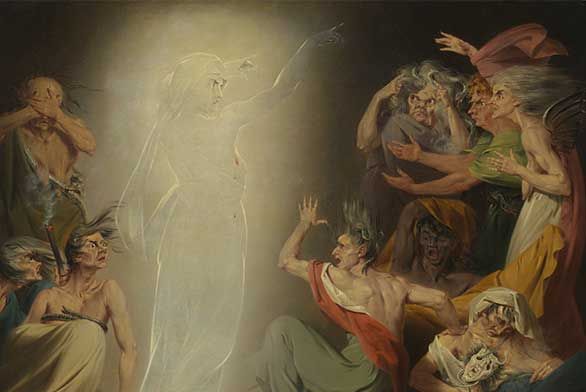
The trope of the vengeful spirit is never more apt than with Clytemnestra. The wife who slaughters Agamemnon on his homecoming, her act throws the family into disarray, which takes a whole trilogy of plays to sort out—Aeschylus’s Oresteia. The final play, Eumenides, opens after Clytemnestra’s own son Orestes murders her to avenge his father. She is enraged. Her fury drives her to invade the dreams of the Furies, a legion of goddesses known for exacting bloody justice.
While Orestes cowers in Apollo’s shrine, hiding from the Furies’ pursuit, Clytemnestra rouses them. She seizes them and, with a spectral voice, screeches in their ears an incitement that reads as follows, per Fagles’ 1977 translation: “You, blast him on with your gory breath, the fire of your vitals—wither him—after him, one last foray—waste him, burn him out!” At her urging, the Furies wake and chase Orestes down, slavering like hunting hounds to eat him alive.
Most of the fictional ancient Greek ghosts we encounter are truly just people, guiding and grieving as they can. That’s what makes the wrath of Clytemnestra so memorable. She seeks nothing but the total annihilation of her desperate son. She will not let his crime be forgotten. She will haunt him to the ends of the earth.
* * * *
Even at the end of this list, we’ve barely scratched the surface of the most remarkable spirits present on the St. John’s College Program. If you’re not satisfied with these picks, just hit the books for seemingly infinite more possibilities—may I suggest starting with Book 11 of the Odyssey? Or perhaps Shakespeare’s Hamlet, or Mozart’s Don Giovanni (featuring what might be the weirdest spirit: a ghostly statue)? Until someone can upstage the terror of Clytemnestra, though, I invite you to carry her image into this Halloween.