
Johnnie Filmmakers Chronicle Journey From Santa Fe to Korea's DMZ
October 9, 2026 | By Jungbin Moon (A26)
Seohyun Lee (SF26) and Ahin Song (SF26) spent last summer in South Korea making a documentary that explores whether peaceful communication is still possible on the Korean Peninsula between brother nations divided by a militarized border. The pair’s two-month filming journey from St. John’s College Santa Fe back to their home country underscored one of the important questions often asked at the college: Why and how do we communicate with each other?
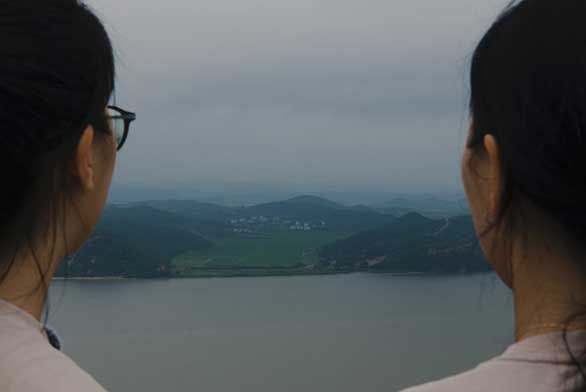
Lee and Song received a Projects for Peace award through Middlebury College in spring 2026 to fund their 50-minute-long documentary on the difficult relationship between North and South Korea. Projects for Peace is a competitive global grant program that provides $10,000 to undergraduate students at eligible partner institutions to design and implement innovative, community-centered, and scalable peace-building endeavors.
Hoping for this project to be an “opportunity to ask the younger generation what the current situation is in the Korean Peninsula and why there is no communication between South and North,” Lee and Song interviewed defectors from North Korea and experts from various backgrounds, including professors, researchers, nonprofit leaders, government officials, and missionaries who have studied North Korea and gained firsthand experience through their respective fields. The two hope that their documentary will “arouse the younger generation’s interest in North and South relations and make people notice the absence of communication between North and South,” Lee and Song say.
The complex relationship between North and South Korea began with the Korean Peninsula’s liberation from Japanese colonial rule by Allied powers following World War II, which eventually triggered the Korean War’s onset in 1950. Liberation from Japanese occupation did not mean ultimate freedom: the United States and the Soviet Union had stationed their troops south and north of the 38th parallel—the line of latitude bisecting the Korean Peninsula—under the pretext of disarming the Japanese military, and they eventually divided the peninsula into two separate spheres of influence.
As one of the first proxy wars of the Cold War, the Korean War resulted in millions of casualties and separated families. Although an armistice signed by North Korea, China, and the United Nations Command brought an end to the fighting in 1953, it failed to establish real lasting peace on the Korean Peninsula, leaving the nation divided by the Demilitarized Zone (DMZ) to this day. The recovery of the remains of more than 120,000 victims is still underway, and many of the family units that were torn apart have already passed away without ever having the opportunity to reunite with their loved ones.
While it might seem natural for Koreans to be interested in and concerned with inter-Korean relations, the younger generation’s interest in the unification of Korea has declined significantly over several decades in South Korea. As the Korean War and its aftermath become more distant from their own lived experience, many young adults consider the conflict between North and South Korea to be a political concern mainly for the older generation.
Not only have they become indifferent to inter-Korean relations, but they have also been easily influenced by the negative images of North Korean defectors framed by Korean mass media. “Refraining from judging so quickly and keeping the fixed conception of them,” Lee says, “I think we should accept and learn who they are, through seeing them as they are.” A journalistic documentary, in Lee and Song’s view, was the best-fitting medium for this purpose—a form of art aiming to present the audience with questions to help them “think for themselves” without assuming what is just or right.
Lee and Song explain that their unique background as Johnnies was the driving force behind this project. Their experience at St. John’s, reading and discussing various works of literature, philosophy, and science with people who are so different from each other, made them reflect on the relationship between North and South Korea—one country separated into two.
“At St. John’s, we believe that we can learn from each other, even though we have different perspectives. That’s the reason why we sometimes try to read controversial texts, such as the Bible, The Second Sex, or Marx, with people who have different religious and cultural backgrounds,” Lee says. “But every time I come back to my home over summer, I see that there’s no communication [between North and South Korea], even though we have the same language, we share a part of our history, and we were actually the same country only 81 years ago. We don’t talk to each other anymore because we know, and we’re afraid, that we’re different ... That contrast between my home [South Korea] and St. John’s really made me curious why we cannot communicate with North Koreans.”
While preparing to embark on their trip, Lee and Song met with Santa Fe tutor Ned Walpin, whom they used as a sounding board. A St. John’s faculty member for more than 20 years, Walpin was at the time preparing to spend the summer at a St. John’s-affiliated Great Books-themed summer camp in Chuncheon City, South Korea, organized by area professors Yonghwa Lee (AGI01) and Kyoung-Min Han.
“I would argue that what we find at the best moments at St. John’s is that, when we let our egos and our desires to share what we’re thinking in our own way, there creates a space, this beautiful, fragile zone, for everyone to actually communicate.” Walpin says. “When I’m playing jazz piano, not looking at the music and forgetting what I’m supposed to be playing, suddenly my self falls away, my hands just do things, and that’s when real music happens. The same is when we’re conversing ... What we’re listening to is not another person, but this thing that’s out there between us.”
Lee and Song remember that their discussion with Walpin “turned out to be a very powerful conversation” that helped them throughout their project. “We discussed what communication is, how difficult it is, and how often it fails,” Song says. “He left us with a thematic question for our documentary: How can we be Korean together?” With advice from Walpin that “the question or the text that would need to be shared” between North and South Korea might be “what our national identity is and how we can be one people,” Lee and Song say they were able to dive into the thematic core of their project.
United in a mission, Lee and Song reflect on working together as co-directors of the film with their different personalities. “She’s really diligent,” Lee says. “Ahin checks her email so regularly, but that email from the Office of Personal and Professional Development (OPPD) was just sitting in my inbox,” inviting Johnnies to apply to Projects for Peace. Lee also remembers that Song would always help her find a better balance whenever she “naturally jumped to make big arguments” about the unification. As their goal was not to persuade people but to help them think for themselves, Song would always try to approach the topic from a neutral standpoint, Lee explains.
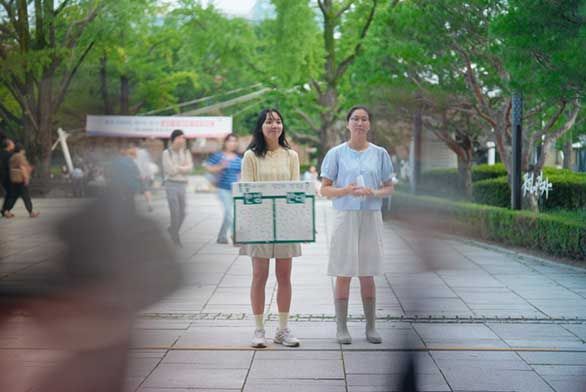
Song adds that Lee helped her overcome her own limits when she had to step up and take part in the filming process as a visible team member. Although it was quite difficult for her to join the public-facing activities that Lee often suggested, Song says she is proud that, thanks to Lee, she was able to try new things that she would never have done on her own: “Through this project, I did things that I wouldn’t have done otherwise, things like interviews and street surveys. We went out to the street and held picket signs with stickers ... I stepped out of my comfort zone and tried things ... that I won’t do ever again.”
Song and Lee also explain that they might not have joined forces if Charles Bergman, the OPPD’s Senior Career Advisor, had not helped them from the beginning, introducing them to each other and providing feedback on their proposal. Lore Dach from the Communications Office was also a great help with pre-production, Lee notes, guiding them in making a budget list for the overall project, building a narrative, and networking with local film directors. “We would really be happy to share our work, especially with St. John’s community,” Lee and Song add, “because they are the ones who supported us the most.”
Lee and Song have now been working on their documentary for nearly a year, after having applied for Projects for Peace in October 2025. Along the way to creating a documentary of their own, the pair reached out and listened to various professionals from diverse backgrounds, spent a week walking along the DMZ with their camera gear, and had multiple conversations with each other about the seemingly impossible prospect of Korean unification.
They also had to deal with difficulties such as an unexpected change of plans due to a delay in their OPT approval: they ended up leaving the States earlier than they originally planned, which forced them to cancel an interview with a professor at the University of Southern California. This scheduling change was serendipitous, since it allowed them to take advantage of other filming opportunities, such as joining the DMZ Walking Camp, where they had a chance to capture border scenery and talk with second-generation defectors from North Korea who had entered South Korea through China.
Lee and Song are just now editing a rough cut of their film after their private premiere in Seoul, but the project has already influenced their future career paths. “After making this documentary on communication between South and North Korea, I now no longer pursue a career as a documentary filmmaker,” Lee says with a smile. “We met around 20 people from academia, government, NGO, and even North Korea—they have their own specialties and different perspectives, but they all work on inter-Korean relations ... I was really into asking questions about communication between South and North through this documentary. After making the film, now I want to see the actual communication between South and North. That’s become my new passion.”
“For me, this experience has made me more aware of my surroundings,” Song adds. “Learning about how difficult it can be for defectors from North Korea to settle in South Korea made me ponder about the social system and our attitudes toward people who live in South Korea but were not born here, which includes but is not limited to defectors ... I want to contribute to a world where diversity is welcomed.”
As Johnnies who are always drawn to big questions without definite answers, Lee and Song say that their Projects for Peace journey left them with questions that they would carry even after finishing their film. Newly enthusiastic about the prospect of exploring various approaches for better inter-Korean relations in non-profits and think tanks, Lee says that now she wonders about how to promote communication between North and South. “I was confused whether we [North and South Korea] are looking at the same destination. Do South and North Korea share the same purpose? That is still a genuine question for me.”
For Song, who wants to pursue migration studies in the future, this project left a broader question about communication itself. “The absence of communication between North and South shows how difficult it is. Even at St. John’s, it is difficult. We are under the same purpose to understand the text better, but it fails sometimes,” Song says. “I think the trajectories and the future of inter-Korean relations will help me find an answer to this question: why do you have to communicate even when it is difficult and looks impossible?”
Lee and Song’s first foray into filmmaking might very well be their last, but their summer with Projects for Peace will continue through the questions they had been asking themselves long before. “It all boils down to this core belief,” Lee and Song say, “that through communication, we can learn from each other. Even though we have different perspectives.”
Lee and Song note that their understanding of peace on the Korean Peninsula has deepened throughout their journey. “I learned that unification is more difficult and more complicated than I thought before,” Song notes, “and maybe we need to redefine what unification means.” Just as we do here at St. John’s, circling around a word for hours and returning to the most basic question just before the seminar ends, Lee and Song’s journey brought them back to a fundamental question they may have been asking all along: What is peace?
Lee and Song created a website called Sotongil, where people can find out more about their project and even request a link to a private screening of their documentary. The two say they are “proud of the way it comes together and makes a resolution through this film,” although their project may have resulted in their exploring even more open-ended ideas than reaching definite answers. Echoing the spirit of their project, Lee and Song add, “We are happy to just ask a question.”