
Back in Print: A Brief History of 'The St. John's Review'
Oct. 12, 2026 | By Kirstin Fawcett (AGI27)
Conversations about great books and timeless questions have never been limited to the seminar table at St. John’s College: they routinely spill into casual quad banter and coffee shop musings, inspire a veritable A-to-Z of extracurricular reading groups, and grace the pages of campus and collegewide publications.
Chief among said publications, for the better part of five decades, was The St. John’s Review: a faculty and student-run journal published through the Annapolis Dean’s Office featuring works of literature, art, history, science, mathematics, and more. Now, following a five-year hiatus incited by challenges including a global pandemic, The St. John’s Review is back in print.
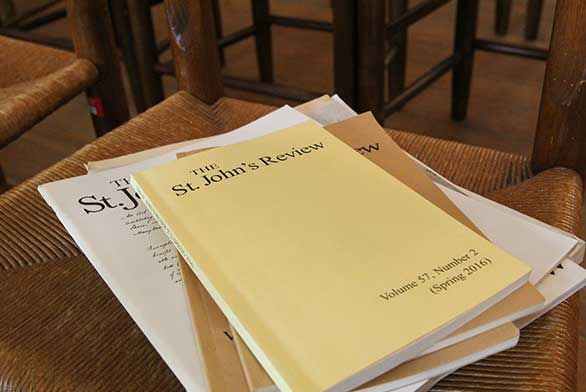
“Print” might feel like a misnomer since The St. John’s Review is now technically a digital-first publication. Resurrected by a small yet tireless tutor group helmed by Annapolis’ Zena Hitz, it returned via a titular website in late September and is currently slated for publication three times a year. Articles will be shared on Substack to reach an even wider readership. Luddites—or, for that matter, those nostalgic for The Review of yore—need not despair, however: Hitz has plans for an annual print edition, available for purchase upon request.
Founded in 1974, The St. John’s Review long distinguished itself from other campus and collegewide publications through its “thoughtful explorations of questions that are connected to the books of the Program or related to it,” Hitz explains. “You’d read in-depth reflections that had taken some time. Part of what makes St. John’s work is not just that we ask good questions, but that we’ve also spent time with the books; we spend years working through them. The Review is part of that ecosystem.”
The Fall 2026 lineup for The St. John’s Review continues the tradition, with “pieces on mathematics, on Homer, on the mysteries of conversation and lifelong learning, and on animal life,” according to a promotional flier. “This issue, like the College herself, contains many ways of speaking and thinking.”
St. John’s, as the nation’s third-oldest college, has had many lives, from its founding in 1696 as the Church of England-affiliated King William’s School; to its rebirth as St. John’s, a secular liberal arts college, in 1784; to its post-Civil War stint as a military academy. In 1937, educational reformers Stringfellow Barr and Scott Buchanan came to Annapolis and launched the New Program. Thirty-seven years after that, in 1974, The St. John’s Review entered the St. John’s story by way of then-sophomore and future Annapolis tutor Joan Silver.
Silver, who was in her twenties, already had a BA from the State University of New York College at Old Westbury. Still, she felt so drawn to St. John’s Great Books curriculum after learning about it at Old Westbury from tutor Eva Brann that she opted to enroll as an undergraduate. The rose-colored glasses came off about two years in. “Sophomore year used to be five classes,” Silver explained. “We had both music and lab, in addition to language, math, and seminar. It was an extremely hard workload, and there was a lot of complaining.”
Silver loved her music class, and especially her tutor: Wendy Allanbrook, a renowned musicologist and the wife of noted composer and concert pianist Douglas Allanbrook. But “out of probably 13 or 14 or 15 students in that music class, only two of us prepared,” she says. “Nobody else prepared for music, because you put seminar, math, and language first, and then lab and music. It was very disappointing.”
Silver was by no means the only disenchanted sophomore. “So, I thought, well, why don’t we start some kind of publication where people can write about these things?” she recalls. Aiming “to create conversation within the community” about mutual grievances, Silver posed the prospect of a new St. John’s campus publication, first to her friends and then to Brann. “It was probably Eva who came up with the name,” she concludes. “The St. John’s Review.”
With Silver as founding editor and a small group of peers recruited to handle production brass tacks, the 1974 debut of The St. John’s Review included pointed critiques of the sophomore-year academic experience. “I think it was our class grumbling about the five classes in sophomore year,” Silver adds, “that led to the change where we now just have four classes, and that year of lab was dropped.” But in addition to Program-focused assessments, it also featured poetry, prize-winning essays, and other works by students—at that point, mostly Silver’s friends and friends-of-friends—as well as tutors.
Buoyed by its initial success, a second issue of The St. John’s Review followed later that academic year. Then, Silver’s junior year rolled around, bringing with it a tempting distraction—one that left no time for a start-up student magazine. “Ms. Brann had asked me to study Hegel’s Phenomenology in her kitchen instead of having seminar,” Silver says. “I’ve said probably too many times that it was an offer one couldn’t refuse.”
So, Silver jumped ship from The St. John’s Review, and without a captain, it ceased publishing; she jokes in retrospect that her brainchild “gave birth to only two issues, and then it took a nap.” Inevitably, someone else—she doesn’t quite remember who—stepped up to the helm and resumed operations, and gradually, as years passed by, The St. John’s Review morphed into “more of a review in the normal sense,” Silver explains, “about the very books that we read, investigating them in a deeper way. It’s been an amazing thing at the college.”
The St. John’s Review has experienced multiple iterations throughout the past 52 years, but in its latest—and longest—incarnation before 2020, it functioned as an official collegewide publication, printed under the Annapolis dean’s purview and edited by a faculty member. This tutor was granted a reduced teaching load to sift through submissions, wrangle text, and tinker with typefaces, and they hired a student editor to help them. One notable Johnnie to hold said student-editor job during the 1980s was Annapolis undergraduate and future St. John’s College President J. Walter Sterling—and several of his fellow Santa Fe educators are slated to follow in his editorial footsteps, albeit on the faculty side.
The St. John’s Review has customarily represented the school’s two locations through its contributors, which have tended to be a mix of Annapolis and Santa Fe tutors, alumni, and students, as well as scholars from like-minded institutions. Going forward, Hitz has structured The St. John’s Review to operate even more conscientiously as a cross-college publication, with an editorial board that includes members in Annapolis and Santa Fe. “It’s good for us as a community, for both campuses, to see what we’re all thinking about and have means of reflection on those questions,” Hitz says.
But at the end of the day, she stresses, The St. John’s Review is not just for Johnnies: thanks to the internet’s reach and platforms such as Substack, anyone with intellectual curiosity, a love of books, and the desire to sit with and contemplate a considered argument instead of mindlessly scrolling can find something in it that speaks to them. “What I think is special about The St. John’s Review, and one of the reasons I was excited about reviving it,” Hitz says, “is that its audience is not scholars. Its audience is the educated person or the person seeking education.”
“The internet,” she adds, “for all its vices, is a way where people can find one another who have common interests and common desires and common values. So, my hope is that we will be able to draw in people.”
Visit the St. John’s Review website to read the latest issue.
See past issues of St. John’s Review on the SJC Digital Archives website.