
Meet the Annapolis Student Club Dedicated to Reading Women Writers
November 18, 2026 | Natalie Boyer (A27)
“It’s too nice out to stay inside!” Delaney Costello (A27) exclaims, jotting “Reading Women Meeting on Patio” onto a chalkboard in the King William Room before shepherding the members of her campus club outside to a smattering of tables and chairs behind the Barr-Buchanan Center. It’s an unseasonably warm October evening, and the small and dedicated group that makes up Reading Women is happy for the opportunity to hold their final discussion of Virginia Woolf’s The Waves (1931) outdoors.
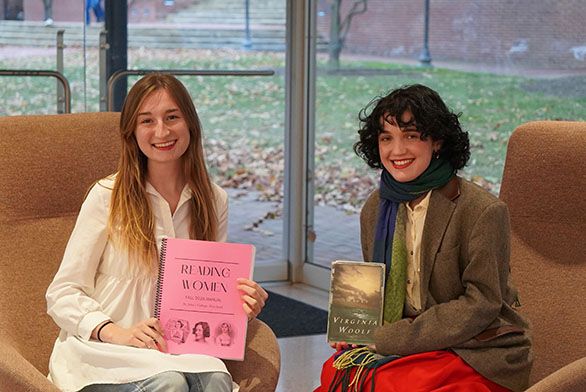
Reading Women, since fall 2023, has functioned as an active weekly reading group-turned official student organization at St. John’s College Annapolis, led by archons Costello and Elleanna Berthel (A27). During her freshman year at St. John’s, Berthel found herself frustrated by a series of “bad seminars.” “We had really good readings,” she says, “with strong female characters, such as Clytemnestra and Medea, who were constantly being misinterpreted… Because there is a lack of representation in the curriculum, people were unable to be articulate about these characters. I wanted a space where that representation existed, and people were able to develop the skills to talk about women in literature.”
Costello, too, was disappointed by what she describes as “a lack of positive representation of women in our freshman readings.” The few women that are present in the readings, which largely comprise ancient Greek epics and tragedies, “are often victims of violence and misogyny.”
Costello wanted to read works by and about women that felt less emotionally exhausting, but “Reading Women was also a general response to social norms,” such as the casual social acceptance of men talking over women in classes, sexual harassment, and assault—things she wanted to push back on.
Ultimately, Berthel explains, the goal of Reading Women is “to give underclassmen a third space to practice being in class, share opinions, think critically; [and] to welcome underclassmen to St. John’s and help make them feel comfortable in class. We also make it our mission to read texts by women, people of color, and perspectives that are less represented in the Program.”
The migrating group settles in behind the Barr-Buchanan Center, and Costello rattles off a series of announcements: Reading Women will be hosting more office hours so participants can discuss campus issues in a safe, casual environment (“There will be snacks,” she promises). There will soon be a field trip to see a new woman-directed film. And the next series of club readings—Lucretia Mott’s Discourse on Woman (1849) and Olympe de Gouges’ Declaration of the Rights of Women (1791)—is available in the Reading Women manual, a curated packet of assorted writings provided for members.
True to their original vision, Berthel and Costello have created the environment they first observed a need for on campus three years ago. Since then, their ranks have expanded: “We have more students from every class now. When we started, we were freshmen, and it was mostly just our friends, but now [as seniors], we get a range of students from all classes.”
Plus, Costello adds, “more men have started showing up eager to discuss works of female literature!” The mix of class years and genders reflects the archons’ overarching goal as a club while illustrating how they’ve changed and grown throughout the years.
Reading Women has grown not only in its range of attendees but in the types of readings it selects and the activities it hosts. “When we started,” Berthel reflects, “we felt compelled to be chronological in the order of works we read, but now we’re doing more modern works, which has been very rewarding.” Funding from the Annapolis Delegate Council, secured after the reading group’s promotion to campus club now also allows them to hold office hours, sponsor campus events, and plan off-campus field trips to places like museums.
St. John’s, in turn, has grown as an institution while welcoming an increasingly diverse student body across the decades. This 2026-27 academic year marks the 75th anniversary of St. John’s accepting women students, and the members of Reading Women take a moment to reflect on what this milestone means to them. “Seventy-five years wasn’t that long ago,” Berthel says. “It’s great that women are allowed to get an education at St. John’s now, but it’s important to remember how recently co-education was instituted here.“ Neither Berthel nor Costello take this fact for granted.
Throughout the remainder of their outdoor autumn meeting, Reading Women analyses themes of grief and identity, discusses The Waves’ final narration sequence, and relates Woolf’s imagery to the novel’s title. Wrapping things up, Costello takes a moment to remind everyone of next week’s reading. Participants filter away, with one remaining for a few minutes to chat with the archons about seminar readings. From their interactions, it is abundantly clear that Reading Women is not just a weekly study session, but a real community.