
Quantum Physics Meet the Great Books at St. John's College
November 13, 2026 | By Jeremy Richter (A28)
In late July, while most of their classmates were on summer vacation, Henry Haggard (A27) and Albert Shapiro (A27) were in a hotel room in Hamilton, New York, studying physics. Alongside Eddie Schodowski (AGI28), director of the St. John’s College Laboratory Program in Annapolis, the two had traveled to Colgate University for a three-day quantum optics workshop hosted by the Advanced Laboratory Physics Association (ALPhA).“We put in about 20 hours of work each, going into this: me mostly in the lab, and Albert mostly with the readings,” Haggard says.
Founded in 2007, ALPhA offers a rotating assortment of training sessions, workshops, and conferences for college instructors teaching advanced physics classes. In addition to a flagship conference held every few years, the organization offers multi-day summer Laboratory Immersions through participating colleges as well as additional educational programming.
Haggard and Shapiro had been invited by lab director Schodowski to attend Quantum Optics Experiments with Single Photons, a 2026 Laboratory Immersion run by Colgate University physics professor Enrique Galvez. Each day began with a lecture and included data collection on the foundational experiments of quantum mechanics. Haggard fondly remembers late nights alongside Shapiro preparing for the following day: “It was fun getting ready for the next morning,” he says, “having serious discussions while working on our papers.”
When many people envision St. John’s College, their minds often go directly to the school’s signature discussion-based seminars. Fewer seem to know that every student is required to take three years of laboratory and four years of math, culminating in their senior year in a study of quantum mechanics and Einstein’s special theory of relativity. Upon completion of the St. John’s undergraduate curriculum, every student graduates with a Bachelor of Arts in Philosophy, Literature, and the Natural Sciences.
The natural sciences have long been fundamental to the St. John’s College curriculum. When Scott Buchanan laid out the laboratory curriculum as dean in 1937, he wrote in the Official Statement of the St. John’s Program, “It is an interesting fact of modern times that the classics and the liberal arts are kept alive chiefly by experimentation.” Haggard and Shapiro have carried on the tradition by working as lab assistants, a role the college has filled with undergraduates since at least 1960.
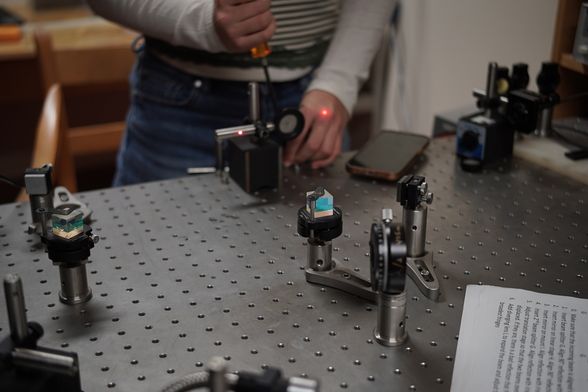
St. John’s College has its very own quantum physics lab in the basement of Mellon Hall. Built by longtime lab director Mark Daly, who retired last spring, it contains tools such as lasers, crystals, polarizers, mirrors, and computers for conducting experiments on the interference and superposition of single photons.
Daly built the quantum lab in Annapolis after visiting Galvez’s lab at Colgate through an ALPhA-affiliated event. Haggard, who first heard about the lab while touring the campus as a prospective student, recalls it as being “this sort of mystical place that I really wanted to see.” Shapiro, for his part, says he was drawn to the philosophical questions raised by quantum mechanics and wanted to assist lab experiments to make sure conversations about the subject were “grounded in some experience that’s worthwhile and presents important questions.”
This past summer marked Schodowski’s first time attending an ALPhA Laboratory Immersion. Faculty and staff in Annapolis and Santa Fe have attended them in previous years; undergraduates had never gone, however, until Schodowski asked Haggard and Shapiro to accompany him. “If everyone at St. John’s is focused on learning, even the tutor, there should be no reason why we can’t bring a lab assistant to a quantum physics workshop,” Schodowski says. Lab assistants, he emphasizes, are “often actually the ones that are setting up the equipment.”
Galvez is known in the academic community for developing quantum experiments that are accessible to undergraduates. His setup, like the one he inspired at St. John’s, uses lasers, crystals, and detectors to allow students to observe quantum effects without years of advanced math training.
Haggard, Shapiro, and Schodowski began their own experiments at July’s Laboratory Immersion with a bare “optical breadboard” that consisted of aluminum tabletops with evenly spaced holes. Their first task was to produce paired photons. “We set up the parametric down-conversion, which splits photons,” Haggard says. “[First], we proved single photons exist, and then we proved that they interfere with themselves, which is impossible [in Newtonian physics], because they are discrete things.”
Next came the quantum eraser. “We made it so that [the photon] doesn’t interfere with itself,” Haggard says, “and then a little bit later, we have it interfere with itself. There’s no really good way to explain that without it sounding like time travel.”
Haggard’s favorite experiment, meanwhile, was a test of Bell’s inequality. The theorem, in Shapiro’s words, demonstrates that “locality and reality cannot coexist on the quantum scale.”
The Program at St. John’s served Haggard and Shapiro well during their first official academic physics event: “Although it’s a liberal arts school, St. John’s has a very rigorous and intense STEM education that allows us to operate at the level of experts in certain places when we do extra work,“ Shapiro says. “It trains us to learn things quickly, even if we don’t cover them in the Program, ”Haggard adds. “[The physicists at Colgate] were impressed by us not because we’re especially good, but because, for our level, we know our stuff.”
Physics at St. John’s is unusually hands-on, although firmly rooted in the Great Books tradition. “Most physics education is textbook heavy,” observes St. John’s Annapolis Dean Suzy Paalman, who earned a doctorate in biophysics and biophysical chemistry from the Johns Hopkins School of Medicine before coming to the college. “St. John’s is interested in learning how to think through phenomena, which is different from strictly solving a problem.&rdquo
Instead, she says, “we read the authors who were initially stumped by a phenomenon,” then “go into our labs and look at the same things those scientists were looking at.” In Freshman Lab, for example, Haggard embraced the role of a scientist observing a phenomenon for the first time: “I came up with an experiment for the ideal gas law, and it worked,” he says. “It’s not life-changing, because everyone already knows that, but I didn’t know that.”
Shapiro believes that conventional textbooks frame the history of physics too neatly. According to some modern accounts, Newtonian physics works until one “miraculous discovery” finds fault with it. “Once you actually dig into the details, it’s not just a miraculous discovery,” he says. “There was a string of problems that didn’t all work together, and assumptions that didn’t fit.” In contrast, physics at St. John’s is “more on the level of the scientist,” according to Paalman. “It’s learning how to account for phenomena. . . . That’s lost at most other places, because they focus on getting the right answer.”
For prospective students wondering whether a Great Books education can prepare them for a career in science, Haggard and Shapiro’s story offers a path forward. At another school, Haggard says, he might have taken a conventional quantum physics course during his freshman or sophomore year. But, he adds, “I don’t think I would be able to grasp the background and history that led to quantum physics being a real, viable science.”
Now well into the 2026-27 academic year, Haggard is putting what he learned through ALPhA’s Laboratory Immersion at Colgate to good use as a senior lab assistant. Fittingly, he and Shapiro will also be among the first cohort of St. John’s College undergraduates to receive a triple major in Philosophy, Literature, and the Natural Sciences, a change in the degree’s name announced by St. John’s last summer.
Paalman emphasizes that Johnnies graduate well-equipped to tackle scientific work. “We have alumni working in scientific fields as principal investigators,” she says. “You can also be a lab technician, a programmer, and a research supporter.” Observing Johnnies like Haggard and Shapiro, it isn’t hard to understand why.